
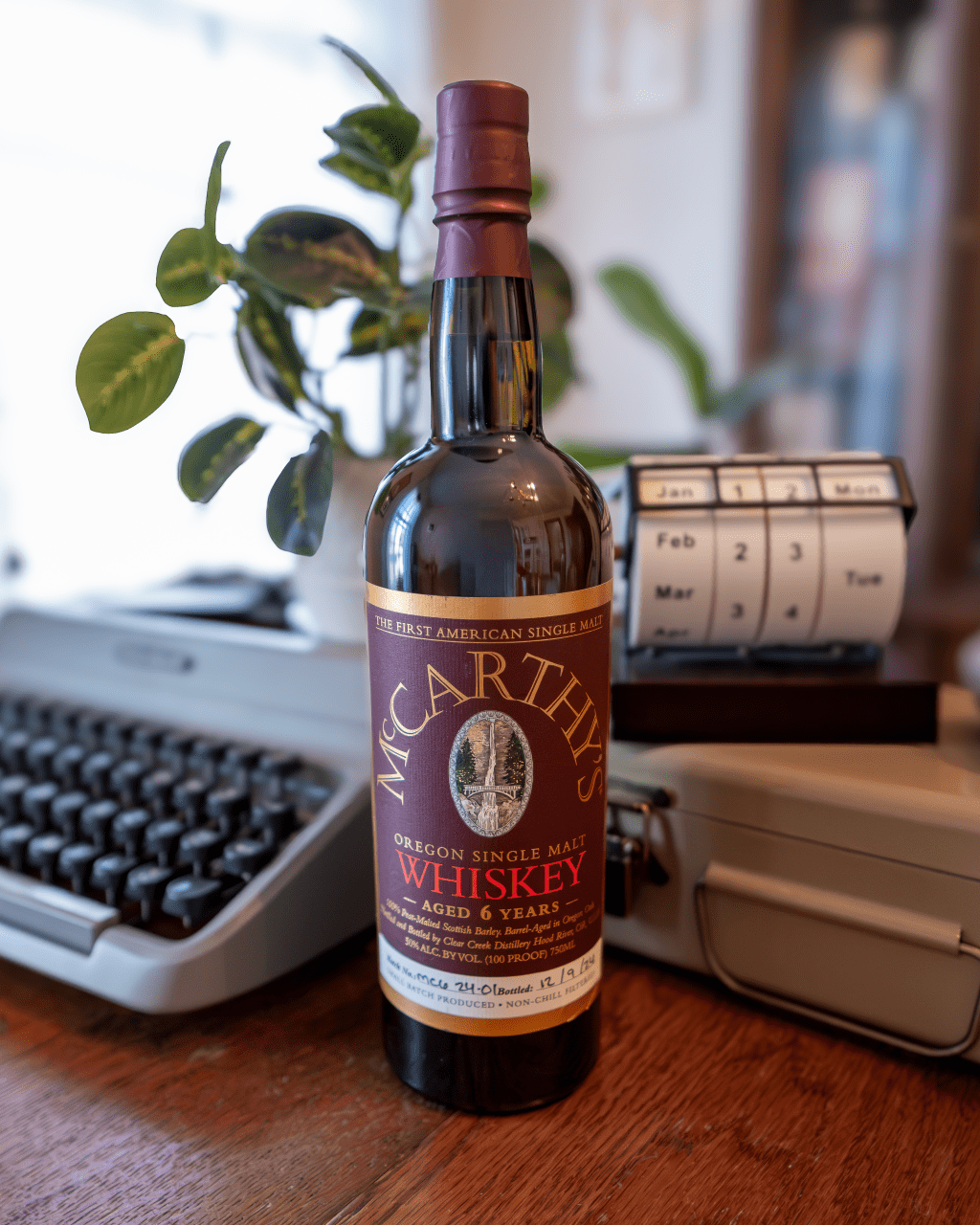
Every story has a beginning, a time and place in which it finds its roots.
For American Single Malt Whiskey, that beginning can be found in Oregon. It was 1994, and the late Steve McCarthy, a lawyer-turned-businessman-turned-distiller, had begun producing brandy made from local fruit nearly 10 years before.
According to legend (and a lovely, worth-the-read feature in Wine Enthusiast), McCarthy’s venture into the spirits world started in Europe in the early 1980s. Traveling back and forth between continents on business, he grew an affinity for the brandies produced there, and decided to replicate their production back home in the Pacific Northwest. McCarthy established Clear Creek Distillery in 1985 in Hood River, Oregon, about an hour outside of Portland.
In the 90s, he turned his attention to barley, and to what would become the first American Single Malt Whiskey.
On a trip to Ireland, McCarthy spent a long evening with a friend and several bottles of Scotch whisky. Diving into the flavors of the spirit, McCarthy was inspired again, just as he had been with the brandies of Europe. Returning home to Oregon, he set to work mashing and distilling malted barley in brandy stills, filling his first barrel with new make malt spirit in 1994.
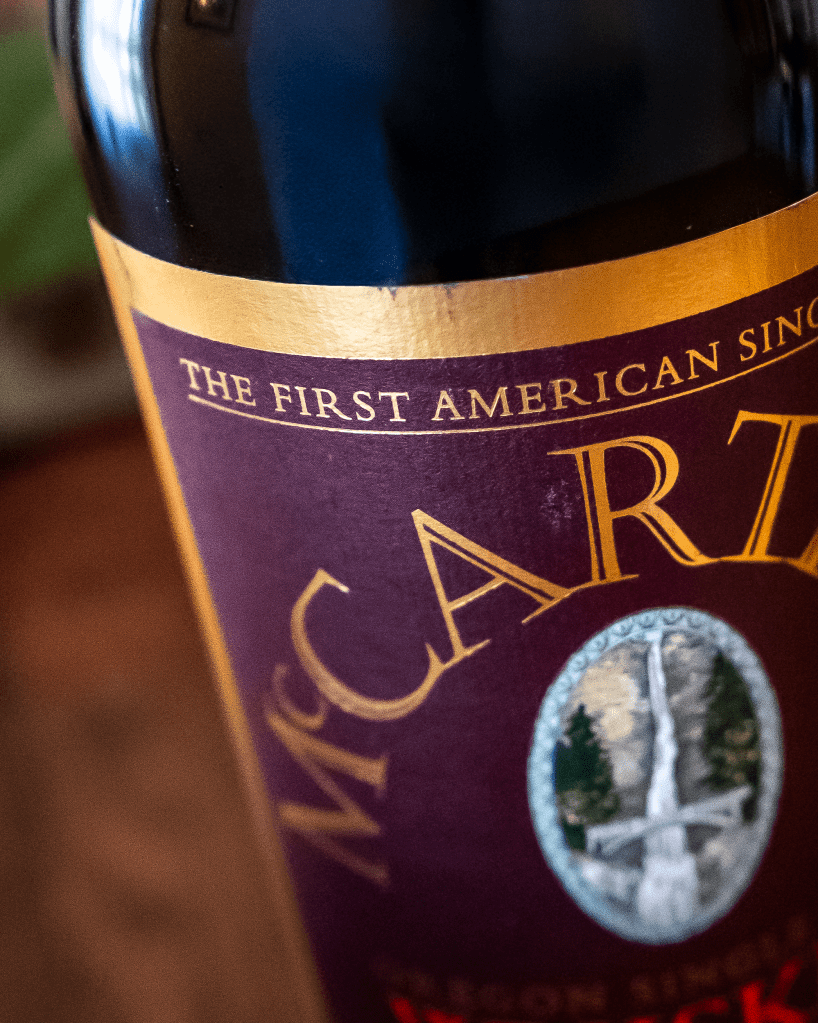
The spirit that emerged two years later was named McCarthy’s Oregon Single Malt Whiskey. It was the first American single malt whiskey on record.
The rest, as they say, is history.
“He didn’t understand he was launching a category,” former Master Distiller Joe O’Sullivan told Wine Enthusiast back in 2023. “At that time, he was just making a whiskey he liked and hoped other people would appreciate it. He wasn’t trying to disrupt the category. He just had a passion about it.”
American Single Malt Whiskey is a category often heralded for its diversity and innovation. It makes sense, then, that it was founded through curiosity and appreciation rather than ego.
Today, McCarthy’s is owned by Hood River Distillers, who bought it from McCarthy in 2014. Operating within the Hood River family, Clear Creek distilling continues to produce Oregon brandies, fermented and distilled from the fruits of the Pacific Northwest.
Using “old-world” techniques and local produce (per the distillery’s website), Clear Creek remains distinctively craft, producing every spirit in small batches.
And I do mean small.
Caitlin Bartlemay, who now oversees the production of Oregon Single Malt Whiskey and other products, explains that all of Clear Creek’s spirits are made on a 60-gallon Arnold Holstein hybrid pot still. Designed in Germany for the making of brandy, the stills are made of 100% copper. That composition, along with their size, allows Clear Creek to remove all of the unpleasant sulfur compounds that naturally occur in their distillate.
For the single malt whiskey, Bartlemay says, this results in “a bold and rich spirit that is balanced by both the grain characteristics and the peat smoke.”
Clear Creek’s hybrid system is especially unique in how it impacts the number of distillations needed to produce a spirit: “We are able to get the proof and style of spirit we like in a single pass instead of a double pass, so the spirit stays heavy and flavorful.”
Now Master Distiller at Clear Creek Distilling, Bartlemay originally joined the team in 2010 as a logistics coordinator under the tutelage of Steve McCarthy himself.
She says that the biggest change in the brand over the last 30 years is its range: “We have added a six year expression and two sherry cask finishes of that six year.” A partnership with Lost Lantern also resulted in a 10 year old Oregon Single Malt Whiskey.
Being the first American single malt whiskey isn’t something that Bartlemay takes lightly, either: “We are honored to be stewards of such a historic brand and look forward to watching it continue to grow with the category.”
Tasting McCarthy’s 6 Year Old Oregon Single Malt Whiskey
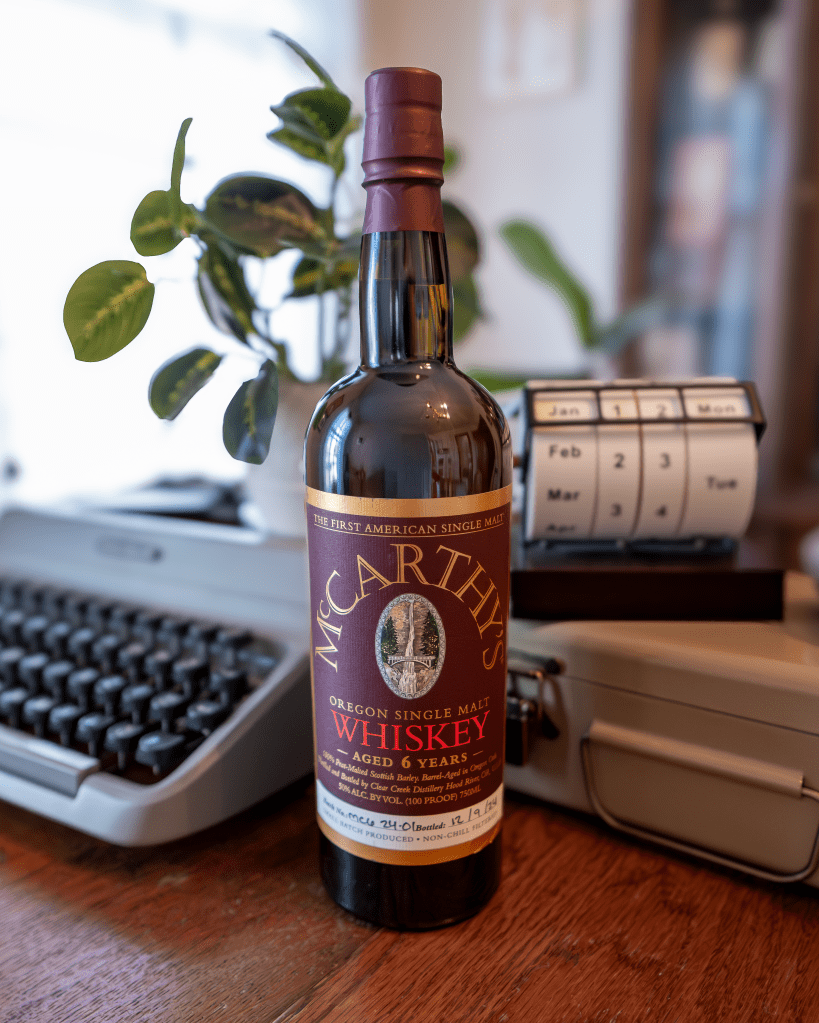
McCarthy’s is bottled in dark brown glass, so I wasn’t sure what to expect of the spirit, beyond the words printed on the label. I have to admit that I like the mystery; whiskey is too often judged by its color, with darker spirits earning higher marks before a taste can prove them otherwise.
Popping the cork, I immediately caught a whiff of that unmistakable smell: peat. McCarthy’s uses peat-malted Scottish barley in all of their single malt whiskeys. But anyone who knows peat knows that not all peat is created equal.
Steve McCarthy’s original whiskey inspiration and guidepost is said to have been Lagavulin 16. While Lagavulin products are certainly peated, they tend toward a more restrained, elevated expression of peat smoke than than their Islay neighbors Ardbeg and Laphroaig.
As someone familiar with that particular whisky, I can appreciate the comparison. Yes, there is a hint of the classic peat brine on the nose (which some might describe as “bandaids”), but the peat in this bottle is not a punch, but a lure. It’s salt air and even saltier bacon, the scent of the sea but also of adventure and curiosity.
(This is where I mention, for those unfamiliar with my work and my palate, that I happily drink some of the peatiest whiskies around. If you do not, take my notes with a grain of salt—pun intended.)
Bartlemay tells me that the spirit is aged in a mix of virgin and non-virgin Oregon oak barrels. There’s no particular recipe for how many of each get bottled together; every batch is blended to taste, keeping the final product consistent even when the process varies.
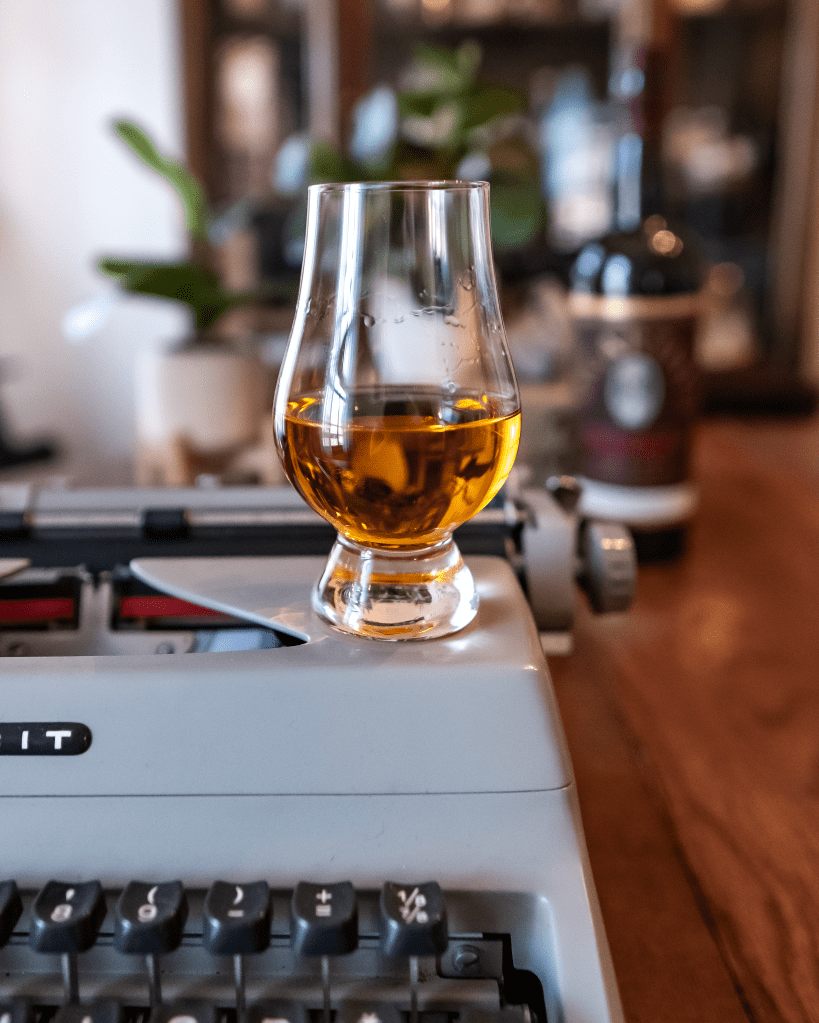
In a glass, the whiskey is golden and bright. I didn’t entirely know what to expect from the dark label and even darker bottle, but it managed to surprise me anyway. A quick swirl left thin peaks around the glass, eventually moving into thin, slow legs that dripped back toward the body of the spirit.
Then, the first sip.
This whiskey elicited a surprised “ooh.” Fruit is not a flavor that I typically associate with peated spirits, especially those that haven’t spent time in a sherry barrel. Peated whiskies are more often heavy and thick, with a certain meatiness to their flavors. But this one has fruit, just as rich and thick as a steak but remarkably brighter at the same time. It’s stewed apples and pastry and maybe pears, if I’d tasted a pear recently enough to be sure of the comparison.
A deep smokiness dances with the fruits, almost like a cobbler cooked over a fire (is that a thing??). The final flourish of smoke comes around at the end, more full and sweet than the typical peat finish, lingering on the tongue with a tingle.

When I poured a couple of drops into my hand, the flavors transformed into a smell of earth and sea, evoking a sense of rich wet ground after the rain. Then, as it settled, into wet socks. I know, that’s not a good smell, but it actually isn’t as bad as it sounds, or even bad at all. I can’t really explain why; it’s not repulsive in any way, but grounding and cozy.
Besides, I only found that particular note between my palms. It’s easily avoidable if you’re not particularly interested in exploring that element of the experience.
At 100 proof, the ABV is substantial enough to be present, but not overpowering. In fact, I don’t get a big punch of ethanol on this spirit. The barley flavors stand in good balance to the booze, their maturity belying their relatively young age statement at just six years.
Quite frankly, as a peat enthusiast, this could easily become a daily drinker. It would be lovely with a medium-bodied cigar, and it’s even a whiskey I’d pour for a non-peat drinker. That fascinating dance of flavors offers just enough peat to tempt the curious, without overwhelming them in smoke.
(I’ve also been known to goad a non-peater into drinking violently peated whiskies, but this one I’d do for a wholly different intention.)
McCarthy’s Oregon Single Malt Whiskey doesn’t just represent just the beginning of American Single Malt Whiskey. Instead, it’s a reminder of how the category was born, and the passion that now defines the category as a whole.
In Hood River, Oregon, American Single Malt Whiskey not only created a category, but a culture of curiosity, patience, and the simple desire to make a whiskey worth drinking.
Sláinte, y’all.
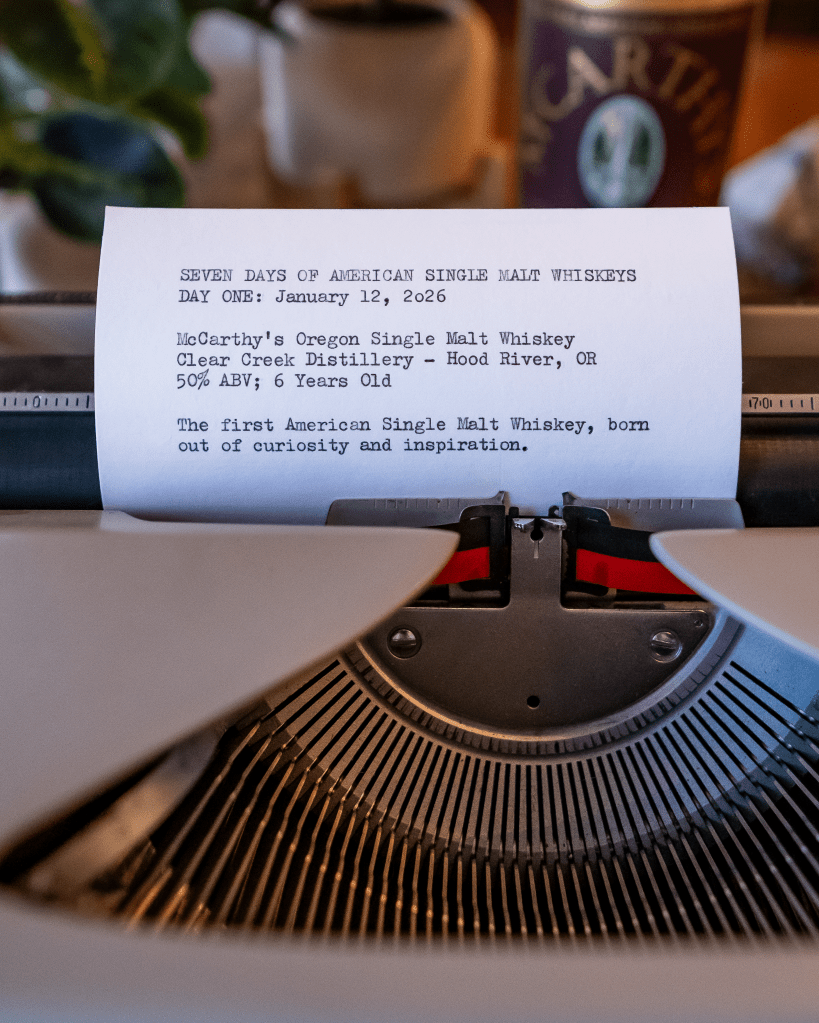
In My Glass
McCarthy’s Oregon Single Malt Whiskey
Clear Creek Distilling – Hood River, Oregon
50% ABV; 6 Years Old
On My Desk
Facit TP1 Typewriter
Read More from the Seven Days of American Single Malt Whiskey 2026
Day Two: New Riff Sour Mash Single Malt
Day Three: Stranahan’s Mountain Angel 12 Year
Day Four: Redwood Empire Foggy Burl Single Malt Whiskey
A Note of Gratitude
This bottle of McCarthy’s Oregon Single Malt Whiskey was sent to me by Caitlin Bartlemay, master distiller for Clear Creek Distilling. Thank you to Caitlin and to the team for letting me sip and share their fantastic whiskey!
 The Whisky Type