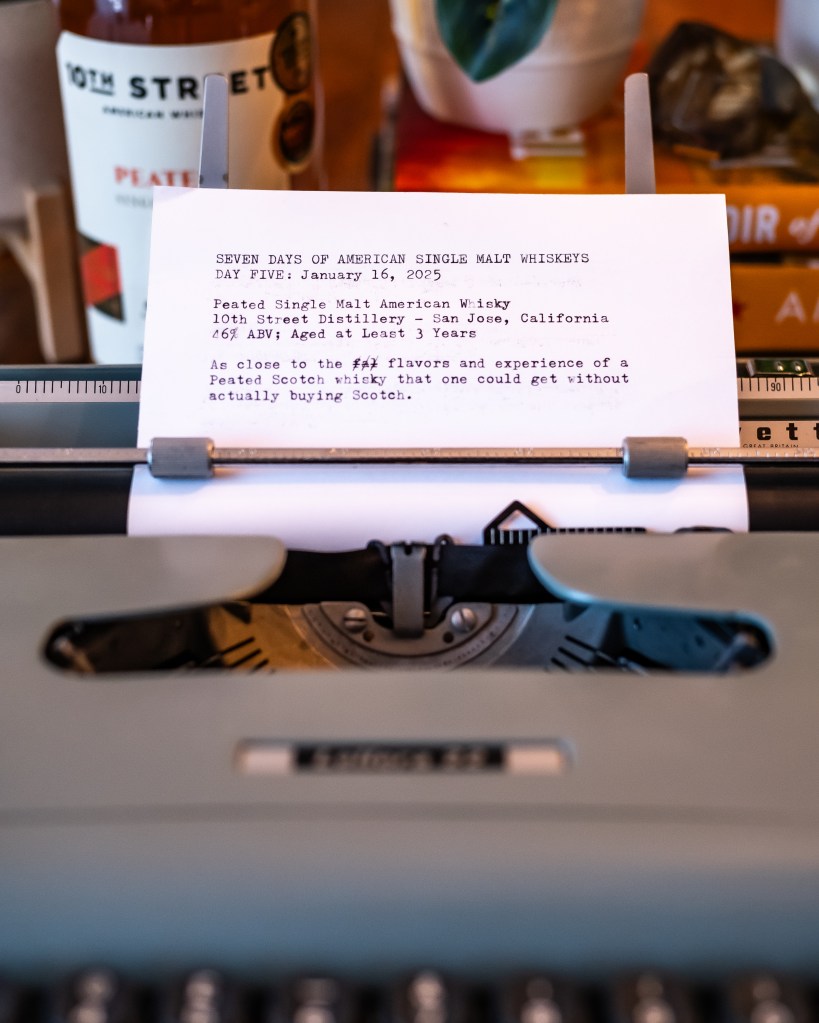
It’s Day Five of SEVEN DAYS OF AMERICAN SINGLE MALT WHISKEYS, a week-long series honoring and celebrating the USA’s newest official whiskey category. The Tax & Trade Bureau’s ratification of American Single Malt Whiskey as a legally-defined subcategory of American whiskey was announced in December. It goes into effect this Sunday, January 19, and we’re counting down to the occasion both here and on Instagram.
All seven of the whiskeys selected for this series have two things in common. First, they’re all American Single Malt Whiskey, meaning that they’re made from a 100% barley at a single distillery in the USA aged in an oak barrel no greater than 700L, distilled to no more than 160 proof, and bottled at not less than 80. In addition, all of the whiskeys I’m choosing to feature already exist in my whiskey cabinet; I purchased no new bottles for the purposes of this series.
Unsurprisingly, that means that some of the whiskeys featured so far are old favorites, or they’re new expressions from a well-loved whiskey maker.
Today’s whiskey is neither. It’s a freshly cracked bottle from a new-to-me distillery, purchased on a whim while shopping online for another particular spirit. Since its arrival, it has held space in my cabinet, waiting to be opened and experienced and introduced to my palate.
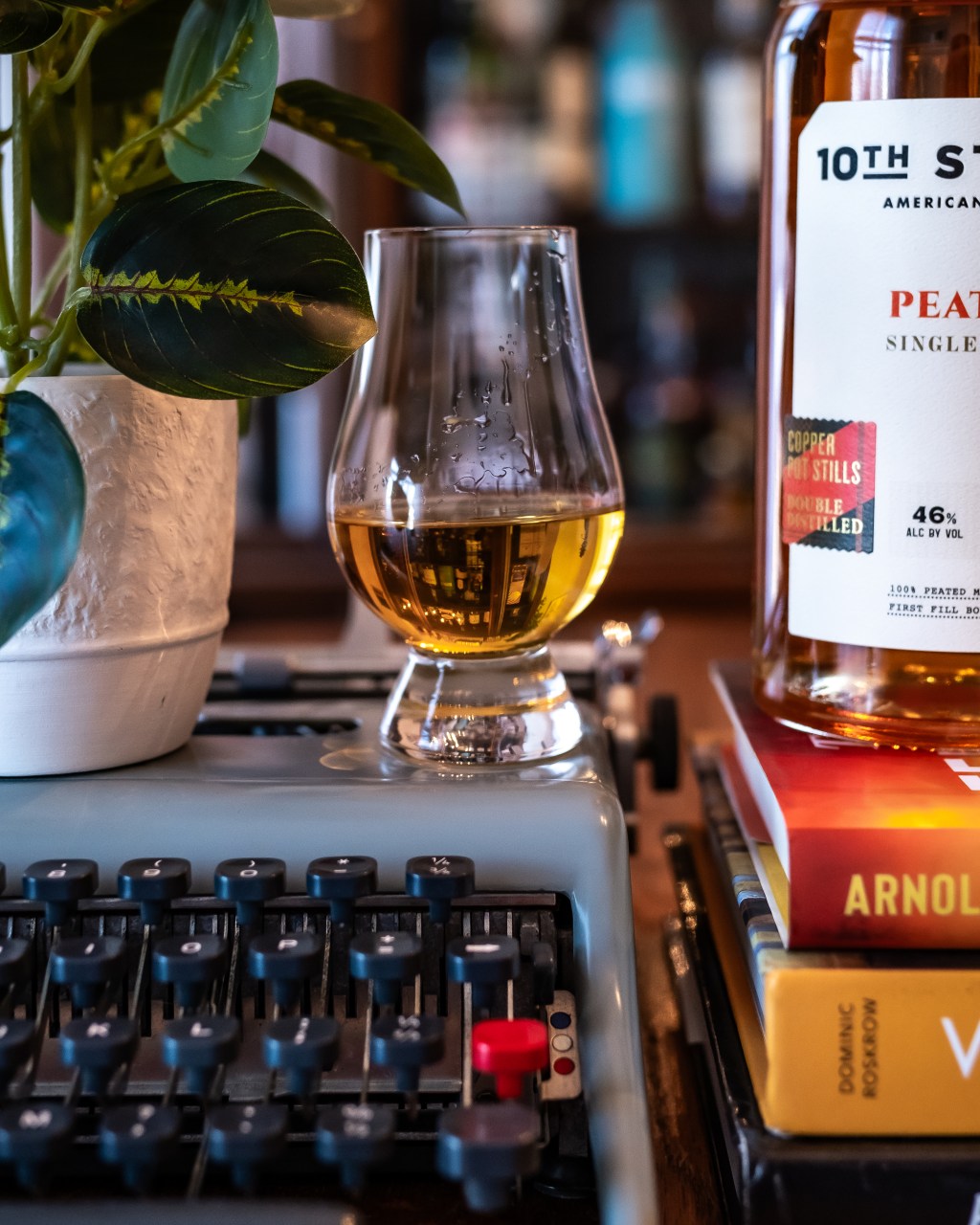
That whiskey—or, as they prefer to be called, whisky—is the Peated Single Malt American Whisky from 10th Street Distillery. As someone who was introduced to whisky through the salty spirits of Islay, Scotland, the idea of a peated American whisky is enticing. So enticing, in fact, that I ordered this bottle with little-to-no research.
I can’t help it; I just love that rich peat smoke. And I got it with the 10th Street Peated Single Malt. The second I popped the cork the sweet smell of brine rose up from the neck of the bottle to tingle my nostrils.
I believe my exact words were “Ooooh.”
For a peat-lover, this whiskey is a delight. Made from peat-smoked malted barley imported from Scotland, it is aged in first fill ex-bourbon barrels for a minimum of three years. The distillery proudly employs a Scotch-inspired distillation process, using a double distillation and custom-built pot stills to produce their new make spirit.
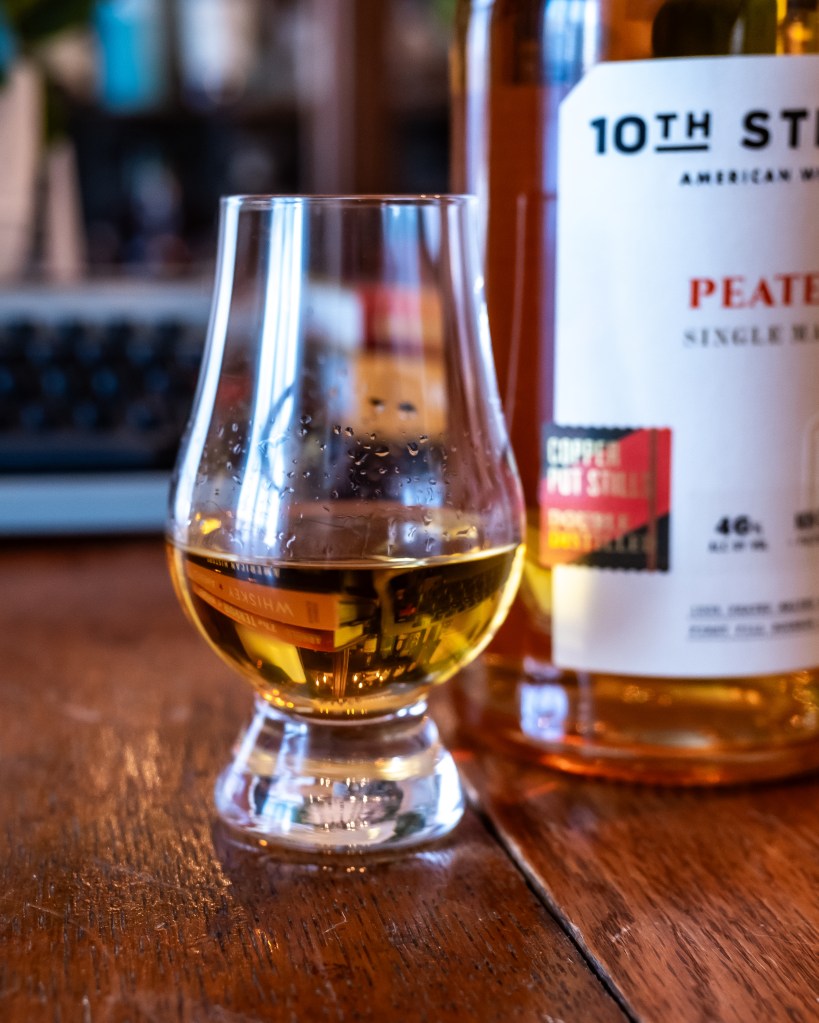
The result is a golden colored whisky with well-balanced flavors of smoke, light fruit, and a hint of vanilla, like gently charred summer peaches with a dabble of cream on top. The smoke, while very present, is refined: not too brash and not too faint.
It’s a deeply enjoyable whisky, and has the awards to prove it. The Peated Single Malt won double gold at the World Wine & Spirits Competition in 2019 and Best in Class from Whiskies of the World in 2018.
And yet I found myself perplexed. Shouldn’t an American whiskey taste more….American?
Terroir is an ever-debated term in the whisky world. It’s the idea that a spirit’s provenance deeply impacts its ultimate flavor profile, thanks to the waters and grains and even the air around it.
Once upon a time, terroir was everything. Farmers, the original distillers, harvested their own grains, grown on the same lands where they were fermented and distilled into spirits. Water was drawn from local sources, and the closest woods or peat bogs provided any necessary fuel.
Even today, many distillers lean wholeheartedly into the culture and flavors of their regions. We saw it earlier this week with the Texas BBQ-inspired Stryker. Virginia Distillery relies on natural spring water from the Blue Ridge Mountains, while Whiskey Del Bac uses mesquite to smoke its barley for Dorado.
10th Street Distillery, on the other hand, seems to eschew these regional calling cards in favor of a flavor profile that can only be described as transcontinental. If not for the California location of the distillery, this whisky could be Scotch. I know that I’m sipping on an American whisky only because I was the one to read, open, and pour from the bottle. If 10th Street’s Peated Single Malt were placed among a lineup of peated single malt scotch whiskies, I don’t know that I could pick it out blind.
Is this still an American whisky if it’s made with ingredients sourced from 5,000 miles away, and if it doesn’t taste like what we’d expect from an “American” whisky?
Yes.
Even in Scotland, much of the barley used to make whisky comes from England or—even worse—continental Europe. The vocal commitment to using Islay barley that is heard from both Bruichladdich and Kilchoman is enough to tell us that their fellow Islay distilleries are likely not doing the same. Same with the peat that they still use to fire their barley kilns; while it may be Scottish, it’s not necessarily from Islay.
And yet we don’t question whether these whiskies are “Scotch.”
The truth is, terroir is only part of the story. Where the grains or the peat or anything else comes from is important. It plays a big role in informing and shaping the flavors in the glass.
The rest, however, is up to the distillers. Selecting those grains, mashing them, fermenting with their choice of yeast and timing, choosing the distillation temperature and speed, the barrels, the rack house location, and the length of maturation—every one of these steps plays a part in the final whisky.
For 10th Street Distillery’s Peated Single Malt, that all happened on American soil. It may taste like a whisky from Scotland, but it’s an American Single Malt Whisky through and through.
Sláinte, y’all.
In My Glass
Peated Single Malt American Whiskey
10th Street Distillery – San Jose, California
46% ABV; Aged at Least 3 Years
On My Desk
1961 Olivetti Lettera 22 made in Glasgow, Scotland
🥃 The Whisky Type is a self-funded project powered by equal parts curiosity, chaos, and whisky. If you’d like to support Carolyn’s questionable life choices and excellent content, buy her a dram! https://ko-fi.com/thewhiskytype
On January 19, 2025, American Single Malt Whiskey becomes an official spirits category in the United States. The ratification of this new category (the first in more than half a century) was announced last month with an effective date of this coming Sunday.
For ASMW distillers and enthusiasts, the recognition of American Single Malt Whiskey as its own distinct category is significant, offering legitimacy, transparency, and accountability to the whiskeys that bear its label.
To honor the occasion, we’re celebrating with SEVEN DAYS OF AMERICAN SINGLE MALT WHISKEYS. Every day this week, I’m selecting an American-made single malt whiskey and featuring it here, on Instagram, and even on LinkedIn. All of the selected whiskeys are already in my cabinet; I didn’t buy any new bottles for this occasion. Some are open and well-loved, while others are yet-uncorked, ready to be experienced for the first time.
Some, like today’s whiskey selection, are a mix of both.
Whiskey Del Bac, the Tucson, Arizona distillery that lives by the mantra “mesquited, not peated,” deserves credit for being the American Single Malt Whiskey that drew me into the category. I lived in Tucson for seven years, with Whiskey Del Bac (also known as Hamilton Distillers) as my home distillery.
That sounds so very magical and right for the whiskey enthusiast I am today, but I have to confess something: while I enjoyed Whiskey Del Bac in a cocktail, or even poured neat, many times over the first four years of my desert life, I didn’t really give this locally-made whiskey a lot of thought.
When I went out, I almost always ordered Scotch. I had cut my whisky teeth on Laphroaig 10, and I was actively planning a trip to visit distilleries 5,000 miles away, with barely a thought to those within the borders of my own country. American whiskey simply didn’t enter my frame of reference—not bourbon, not rye, and certainly not American single malt whiskey.
All that changed when I visited Whiskey Del Bac in late 2021.
The shift really began in 2020, when the pandemic forced all of us to spend far too much time at home. I was lucky enough to continue working remotely throughout the lockdowns. Like many people in my situation, my bank account rose, my usual spending outlets suddenly limited by the seclusion. I started buying more whisky as a result, and, with an abundance of free time, learning more about the craft of distillation too.
My then-partner and I had been planning a trip to Scotland—a bucket list item we’d set together back in 2013 when we got married. As I enthusiastically dug into the details of the trip (canceled, of course, for 2020), I naturally began to research the distilleries we would visit too. And then I began to watch documentaries about whisky.
And, well, it all spiraled from there. Quickly.
I obviously knew about Whiskey Del Bac by then, and I had thought about visiting the distillery on a handful of occasions. The idea of a tour, however, always seemed to come to me in the summer. The distillery’s website warned that the facilities weren’t air conditioned. As a result, they could become extremely warm on Southern Arizona’s needlessly hot summer days.
For this thick-blooded Michigander, it was thanks, but no thanks.
I finally booked a tour in late 2021, prompted (if I recall correctly) by yet another encounter with Whiskey Del Back out in Tucson at large. It was only my second distillery tour ever, and my first single malt tour. By the end of the tasting, my vague appreciation for the desert-made spirit had risen exponentially. When they advertised a job posting for tour guides a couple of weeks later, I immediately applied.
Within a month of visiting Whiskey Del Bac for the first time, I was on the payroll, learning about the distillation process well enough to offer that same knowledge to others. By the time I left, just a short six months later, I was a fully-developed American Single Malt Whiskey enthusiast.
Whiskey Del Bac remains my favorite American Single Malt Whiskey distillery, in part because of all that it gave me.
You might have noticed sentimentality as a common thread in the narratives so far this week.
Yes, I’ll admit it: I’m a sentimental fool.
I still count many of my Whiskey Del Bac colleagues as friends, even almost three years and 2,000 miles later. Without that experience, without having lived in Tucson and walking through their front door, I probably wouldn’t live in Kentucky, and I absolutely would not be doing this series.
It helps that they make damn good whiskey too.
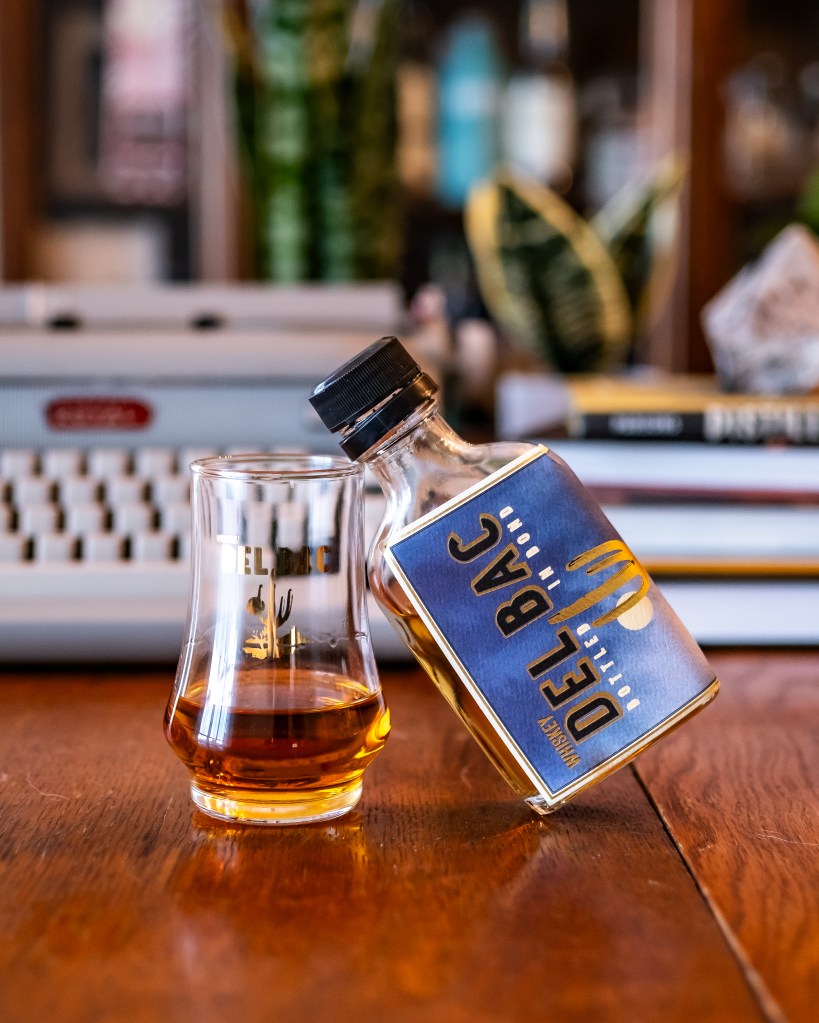
Today’s selection is a little bit of old and new. While the distillery is known for their mesquited single malt, called Dorado, the Classic Single Malt is an unsmoked whiskey modeled after a Speyside Scotch. It’s meant to offer a straightforward whiskey experience, not a campfire, but a bold, enjoyable whiskey experience all on its own.
Historically, the distillery has always aged its whisky in new American Oak quarter casks, each holding around 15 gallons of spirit. As a tour guide, I used to surmise (and never actually verified) that the sizing was a result of the distillery’s humble origins. Smaller casks casks are much easier to fill, maneuver, and store than the standard barrel—especially for the one-man operation that Whiskey Del Bac was in its earliest days.
The diminutive size of these barrels, paired with the extreme temperature swings of the Sonoran Desert, typically produces a mature, delicious whiskey in little more than a year.
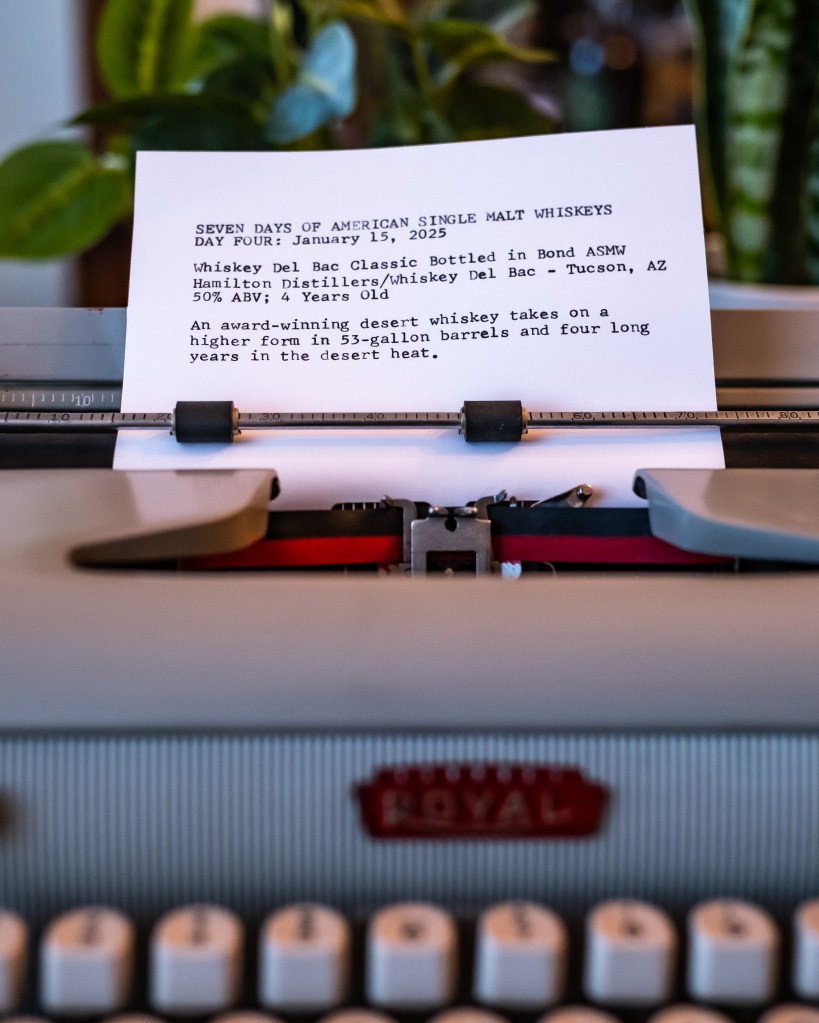
The Whiskey Del Bac Classic Bottled in Bond—today’s American Single Malt Whiskey selection—was instead aged for four years. It is made from the same unsmoked new make spirit as the original Classic, carefully produced in a single distilling season. But instead of being poured into small barrels, the new make spirit was loaded ino new Standard American Barrel holding roughly 53 gallons. The casks were stored as legally required for bottled-in-bond, aging for at least four years in a federally bonded warehouse in Tucson, then bottled at 50% ABV.
Only a small batch of spirit was produced in this way back in 2020, the precious liquid allocated to an experiment with results yet unknown. In 2024, the larger-than-usual barrels were emptied and bottled as a limited release. This small sample sent to me by my friends at the distillery, and has waited until today to be opened and enjoyed.
The color of the Classic Bottled-in-Bond is slightly darker than the usual Classic whiskey. The flavors, too, are a little bolder. This is unsurprising, considering that it’s bottled at 50% ABV instead of the usual 46%. Beyond that, it is the same dark fruit, sweet caramel, and warm vanilla whiskey that I’ve grown to love over the last several years. It’s just a little more robust and more flavorful—and that’s saying a lot, considering that the original Classic was listed in Wine Enthusiast’s Top 100 Spirits in 2021.
In short, I love it. If you’re a fan of American Single Malt Whiskeys, you just might too.
Sláinte, y’all!
In My Glass
Whiskey Del Bac Classic Bottled-in-Bond American Single Malt Whiskey
Hamilton Distiller/Whiskey Del Bac – Tucson, Arizona
There are only five days left until the U.S. Tax & Trade Bureau’s ratification of American Single Malt Whiskey goes into effect. If you’ve been following along around here or on The Whisky Type Instagram account, you know that we’ve been celebrating since Sunday, counting down to January 19 with Seven Days of American Single Malt Whiskeys.
Our chosen spirit this afternoon is a little bit different than the first two. It’s an American Single Malt, of course, but this particular distillery prefers the e-exclusionary spelling of whisky. Plus, it’s not just one bottle we’re opening. It’s four.
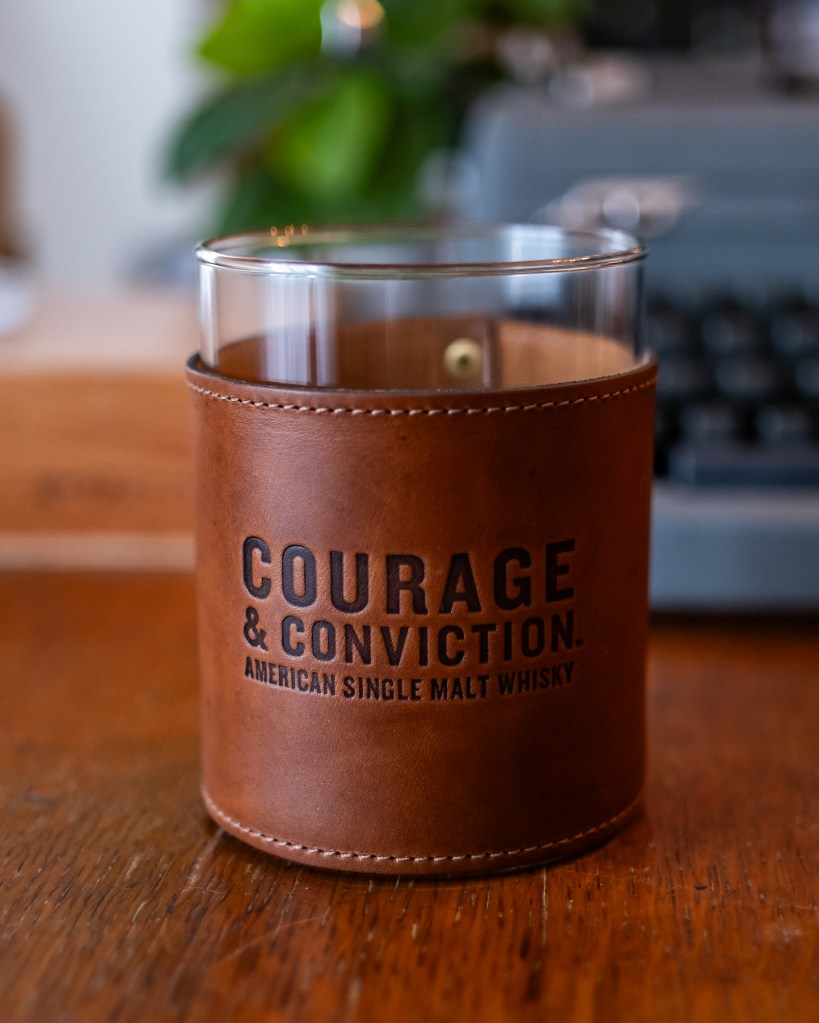
As one of the founding members of the American Single Malt Whiskey Commission, Virginia Distillery has been making its 100% malted barley whiskies in the Blue Ridge Mountains since 2011. The name Courage & Conviction comes from their late founder, Dr. George G. Moore, and his oft-repeated expression, “Have the courage of your convictions.”
Courage & Conviction is not a singular whiskey. It’s a brand, a range, and a varied experience, all rooted in the same core values: malted barley and natural Blue Ridge spring water.
I first tried Courage & Conviction last February while attending the ASMWC’s convention in Denver. If memory (which is a little fuzzy after quite a bit of whiskey and time), I tried the single barrel Cuvée Cask expression—and loved it.
I wanted to know more, and particularly to experience the Courage & Conviction’s core range of whiskies. Back in July, I ordered the four pack featured here along with a full-sized bottle of the Signature Malt whisky. Thanks to a shipping issue, a quick email, and a follow-up phone call, I found myself attending the Bourbon Women Sip-osium as a guest of the distillery a month later.
And they say drinking whiskey won’t get you anywhere in life.
Virginia Distillery’s afternoon event during the Sip-osium took me and several other guests to Clayton & Crume, an artisan leather shop in Louisville. We drank, we snacked, and we made leather sleeves to fit on rocks glasses, each one embossed with the Courage & Conviction logo.
More importantly, we learned about the art of blending from Virginia Distillery’s Lead Blender, Amanda Beckwith.
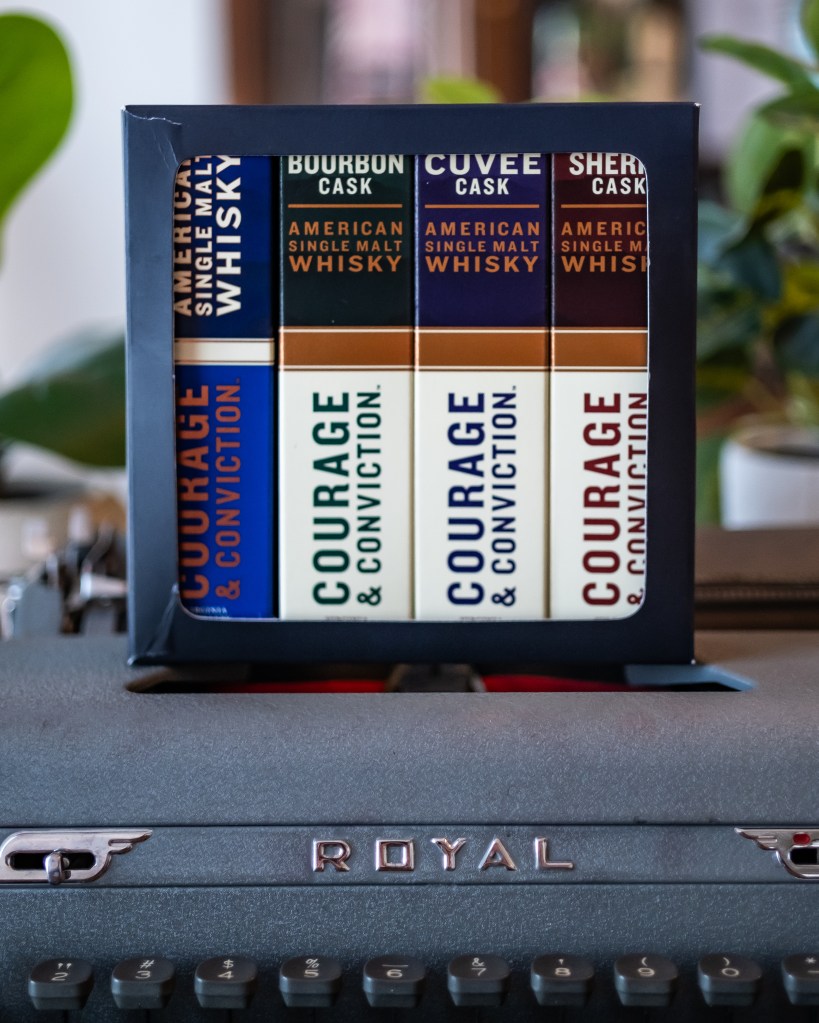
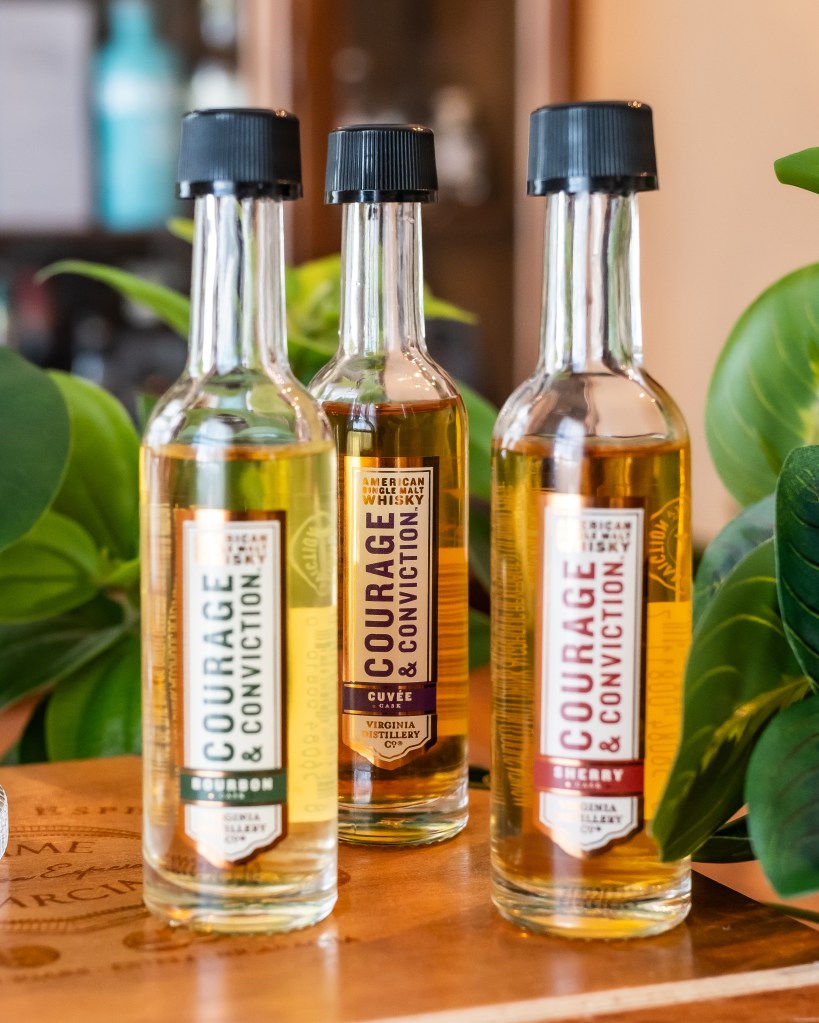
The core range of Courage & Conviction consists of four whiskies, each 46% ABV and aged for a minimum of four years. The difference lies in their finishing. There’s the Bourbon Cask, the Cuvée Cask, and the Sherry Cask. The fourth core whisky, Signature Malt, is a blend of the other three.
You can buy each ready-made expression on its own, or pick up a 50 ml sampler like I did. And you could drink them as they come, sipping on each separately.
But Virginia Distillery has a unique approach to their consumer engagement strategy, which might change how you enjoy their whisky: this is a distillery that believes in audience participation.
The sampler pack of Courage & Conviction whiskies comes with a QR code. You can scan it to enjoy a virtual tasting experience with Amanda, deepening your experience of each sip.
Plus, with each of the three core component whiskies on hand, whisky enthusiasts can create their own blend of Courage & Conviction, selecting the specific amounts of each component whisky to include in their glass. Sometimes, whisky fans like me can even order a bottle of their own unique blend. This special offering, called The Draftsman, comes with a special label indicating the percentages of each whisky contained within. It also bears the name of the person who “drafted” it.
Let me just say from experience: it’s really cool to see your own name on a bottle of whisky.
My version of The Draftsman is 40% bourbon cask; 20% cuvée cask, and 40% sherry cask. I chose and ordered that particular blend in Louisville. After telling us about the distillery’s history and the basics of her trade, Amanda gave each of us small amounts of the three base whiskies along with pipettes, a place to take notes, and instructions to play.
As someone who was never really into science, it was the most fun I’ve ever had with a pipette. The fact that I was sampling my experimental blends along the way probably helped.
Unfortunately, I can’t find The Draftsman on the Courage & Conviction website right now, but that doesn’t mean you can’t blend your own at home if you have all the necessary parts. Plus, VA Distillery’s audience participation options don’t stop there. They also offer a free online education program to learn more about American Single Malt Whiskey, called the ASM Academy.
Oh, and how are the whiskies? Fantastic.
The Bourbon Cask is light and creamy, with hints of vanilla and malt a pinch of spice. The Cuvée Cask is comparatively dark and rich, digging deeper into the baking cabinet to pull out notes of brown sugar and even more spice. The Sherry Cask hits the tongue with a bold blend of fruit and leather. The Signature Malt pulls notes from all three, with a gentle layering of flavor that has earned it several 90+ point ratings.
The good news is this: for an amateur blender…you pretty much can’t go wrong drinking or mixing these whiskies.
Sláinte, y’all!
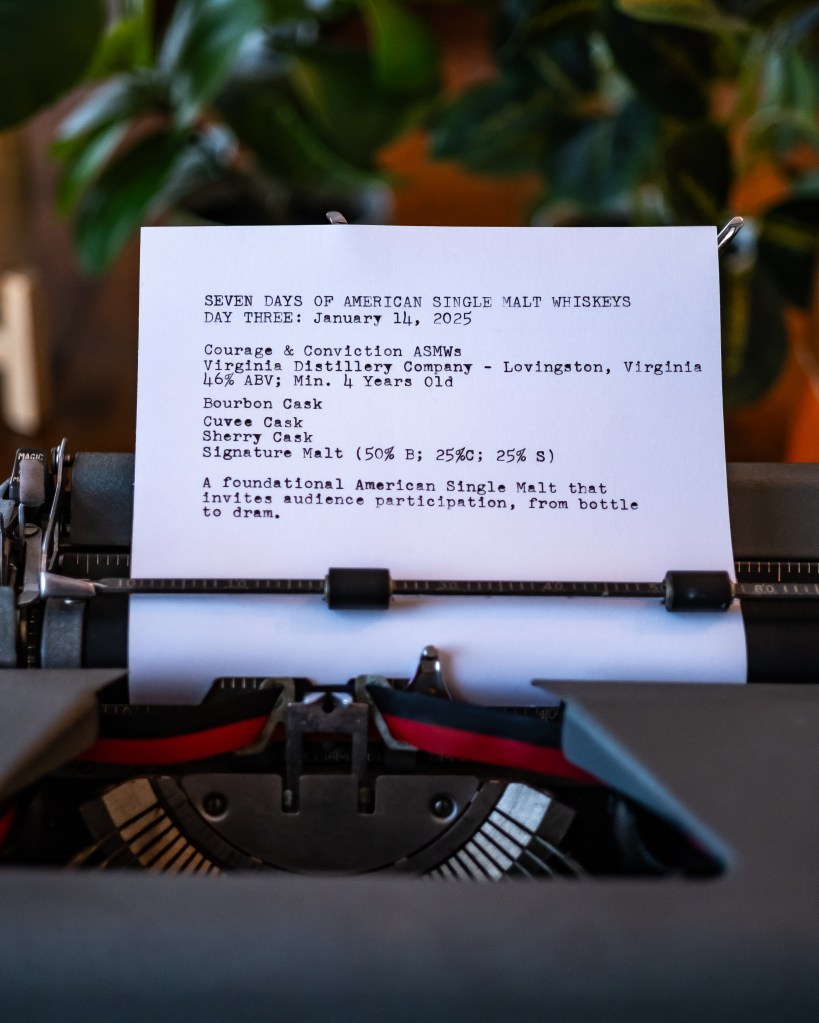
In My Glass(es)
Courage & Conviction American Single Malt Whiskies
Bourbon Cask, Cuvée Cask, Sherry Cask, and Signature Malt
Virginia Distillery Co. – Lovingston, Virginia
46% ABV; Min. 4 Years
On My Desk
A still-new-to-me Royal Quiet De Luxe in its dining room debut.
Just six days to go until American Single Malt Whiskey goes into effect as an official TTB category!
Today is Day Two of SEVEN DAYS OF AMERICAN SINGLE MALT WHISKEYS, my personal celebration of this momentous occasion and the amazing ASMW whiskeys being produced from coast to coast.
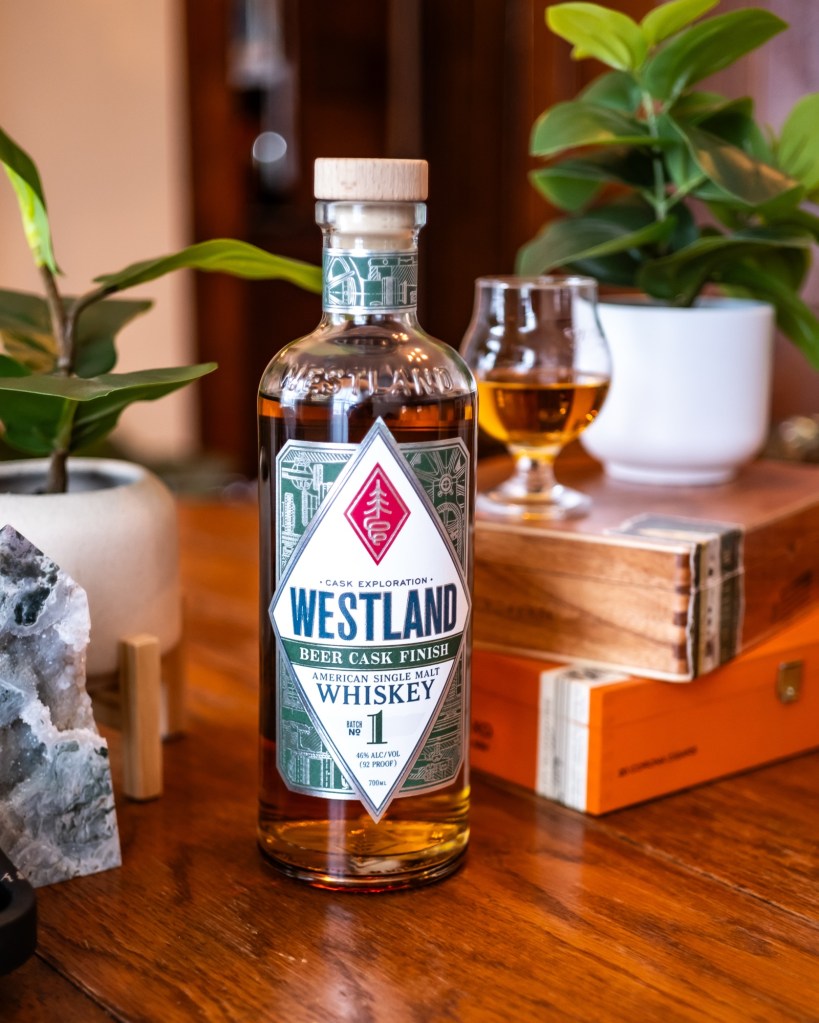
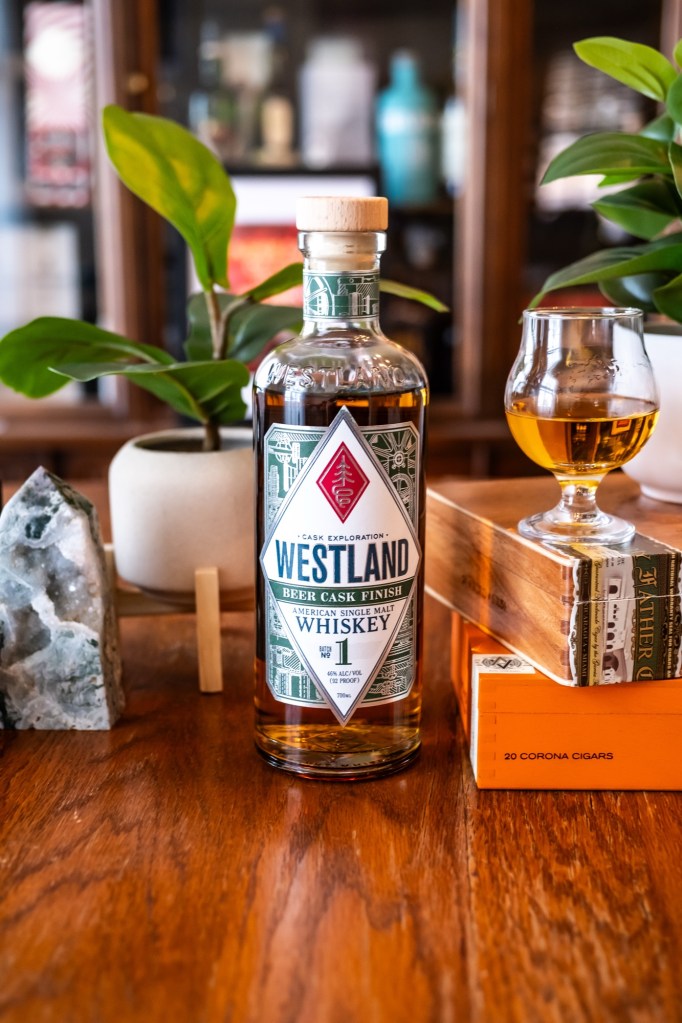
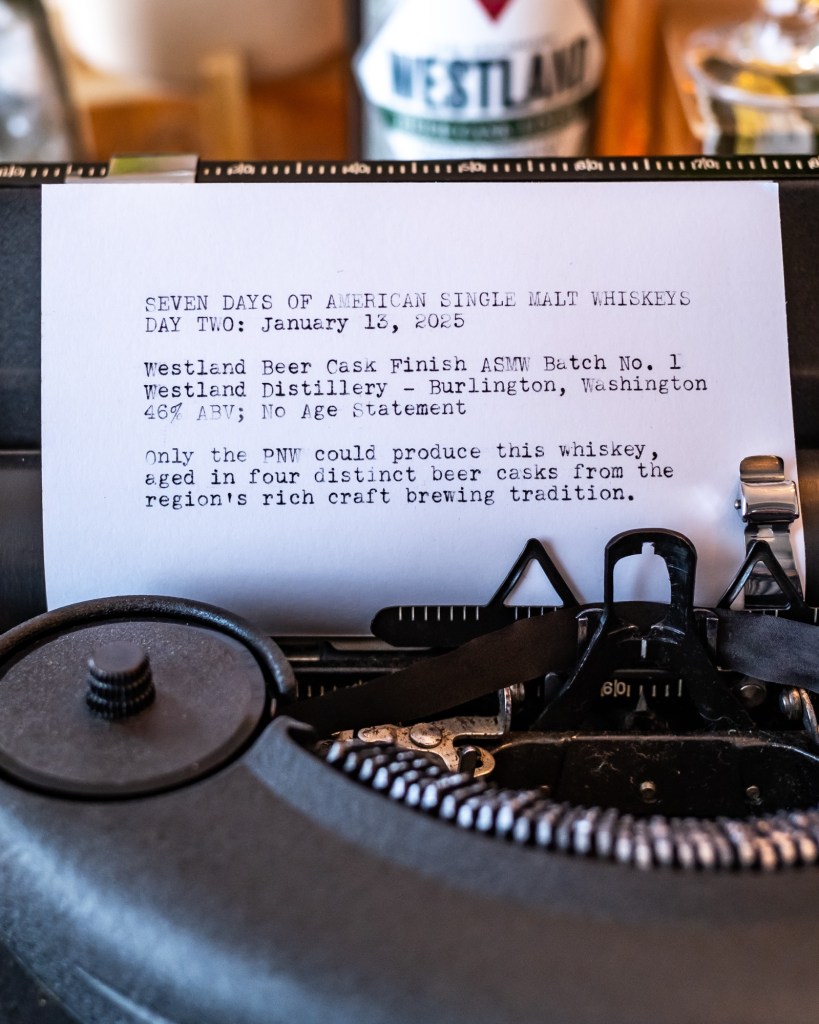
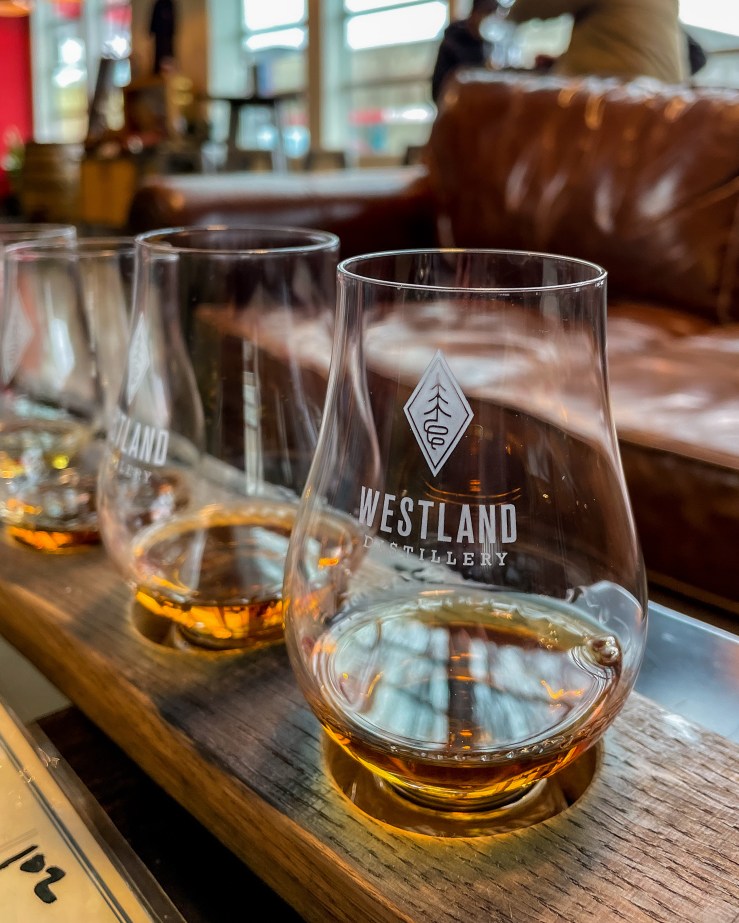
Today, I pulled out—and freshly uncorked—a bottle of Westland Beer Cash Finish American Single Malt Whiskey, Batch No. 1.
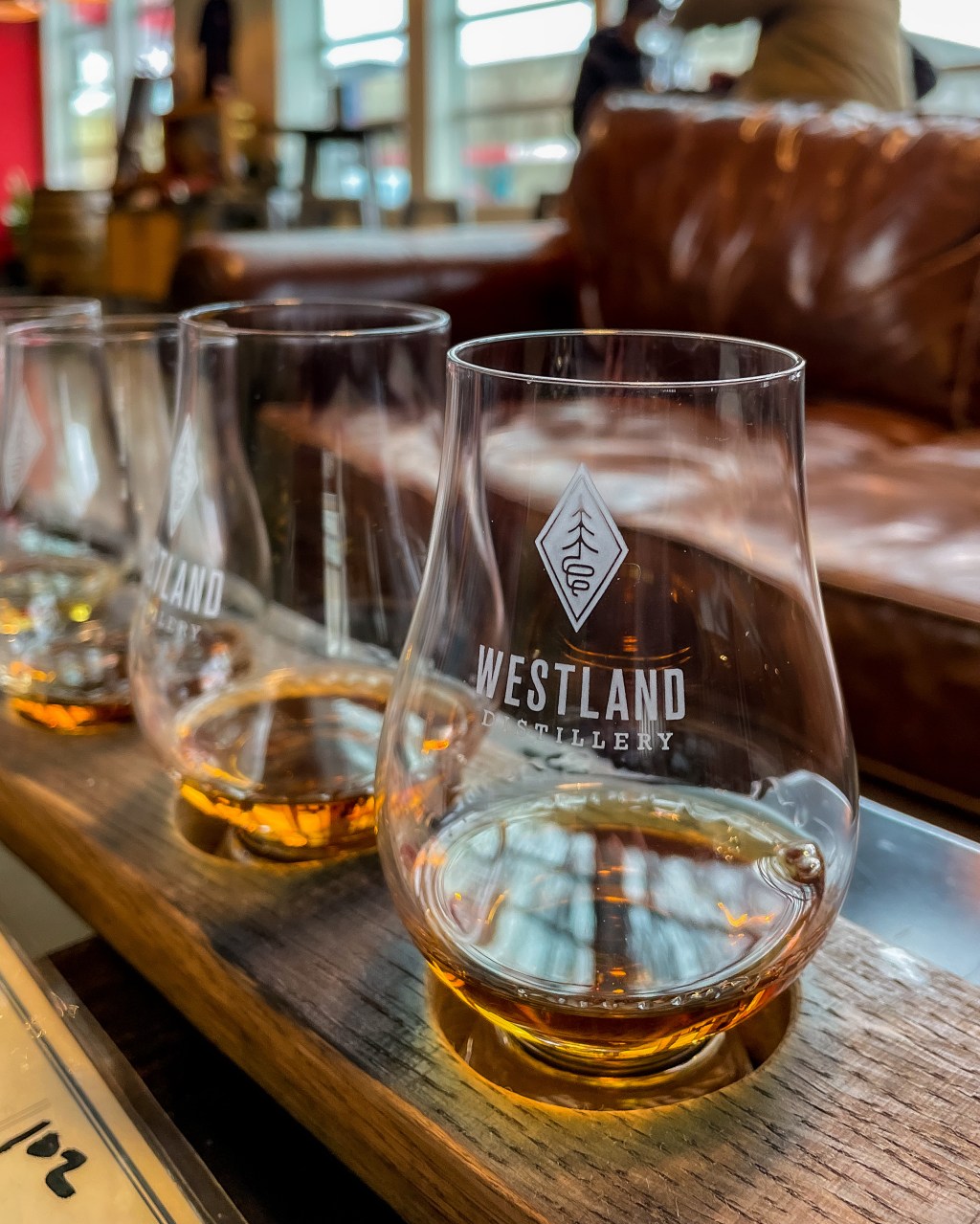
I visited Westland Distillery‘s Seattle-area headquarters about three years ago, and have had a soft spot for the distillery ever since. It was the first time I really got a sense of the community of whiskey, and especially the community among ASMW distillers and fans. I was working as a tour guide at Whiskey Del Bac at the time, and I casually mentioned it when we arrived, just to say how excited I was to be there.
The distillery didn’t yet have tours up and running after COVID, but my companion and I were immediately treated to a mini tour of the facilities, even taking a tiny sip of still-developing whiskey products in the distillery’s lab. Two weeks later, when our impromptu tour guide happened to be in Tucson, I connected her with my colleagues to ensure she got the same warm welcome.
We walked out at the end of the visit with two bottles: their flagship ASMW (the original version) and a “Cask Exploration” bottle featuring whiskey aged in a cask that previously held Redhook Brewery’s Stratosphere Barley Wine Beer.
The distillery has grown and changed significantly since then, sharpening their focus on a refreshed core range of whiskeys in 2024. I got to revisit the Flagship Single Malt with my whiskey advent calendar in December, but I also recently picked up this bottle of Beer Cask Finish American Single Malt Whiskey.
According to the label, this whiskey “celebrates the Pacific Northwest’s long tradition of craft brewing by integrating saison, stout, scotch ale, and doppelbock casks” to finish the whiskey. A total of seven different breweries partnered with Westland to provide (or perhaps return) barrels for the inaugural batch.
There’s no age statement on the bottle, but the distillery notes a minimum age of 8 years, more than double the Flagship’s 40 months.
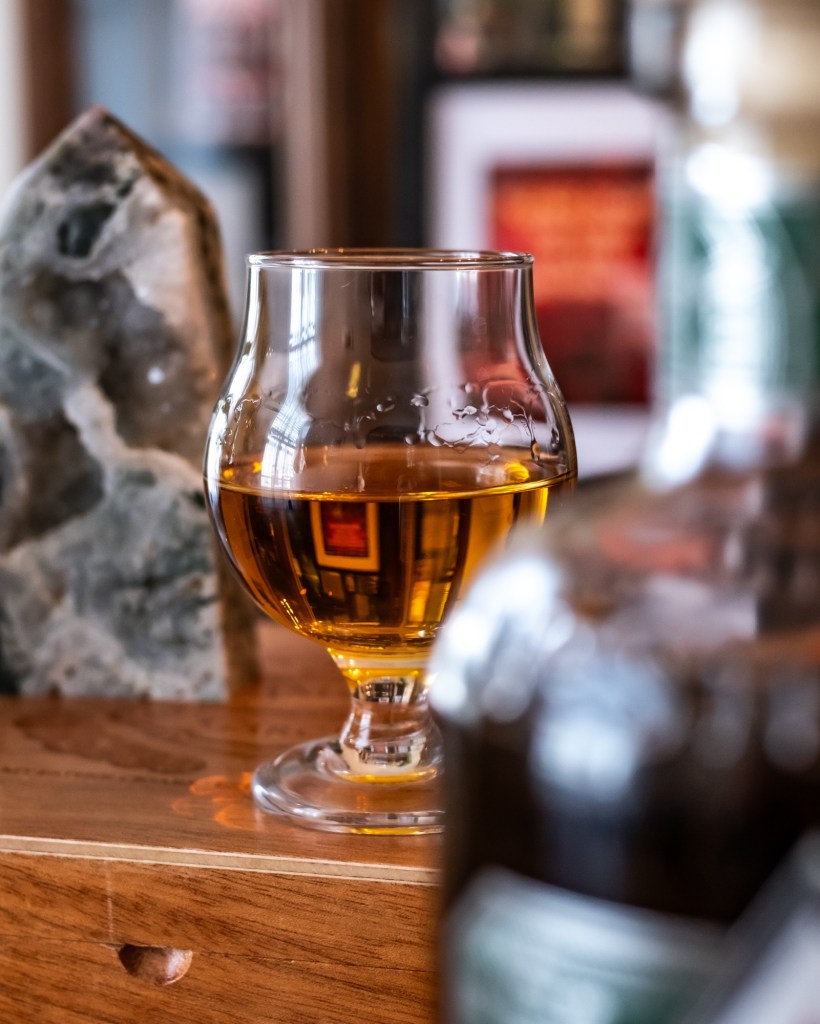
At first sip, it’s whiskey, malty and true with hints of fruit and vanilla. Of course, it’s whiskey all the way through, but the finish? Oh man, that’s a saison. It’s been a long time since I’ve had a saison beer, but that crisp, lingering, straight-from-the-earth influence is absolutely unmistakable.
It’s nuanced, layered, and delicious. It’s also a whiskey that could only be “thoughtfully produced” in the PNW, crafted and infused with the terroir and culture of that region.
Sláinte, y’all!
In My Glass
Westland Beer Cask Finish American Single Malt Whiskey, Batch No. 1
The Tax & Trade Bureau’s official definition of American Single Malt Whiskey goes into effect on January 19, 2025—just one week from today. As most whiskey people already know, the category’s ratification was announced in December. It marks the first new American whiskey category defined by the TTB in more than half a century.
For ASMW distillers, this ruling is monumental. It marks a coming of age, placing American single malt whiskeys at the proverbial table alongside the long-established categories of bourbon and rye.
The ruling is equally important for American Single Malt Whiskey enthusiasts. The publicity, momentum, and legitimacy made possible through this ruling is expected to increase interest, access, and production of ASMW across the country and the world.
A rising tide lifts all boats, as they say.
I am excited to see where the ASMW category goes in the coming months and years. The distillers who pioneered and defined this category are already known for their innovation and their grit. Despite being an underrated, unofficial, and largely unknown category for decades, ASMW distillers have persevered to craft incredible spirits out of equal parts barley malt and passion.
To celebrate the elevation of ASMW to official status, I’m counting down to January 19 in the best way possible: with whiskey. Today kicks off a brief series I’m calling Seven Days of American Single Malt Whiskeys. Over the next week, I”ll be opening, drinking, and enjoying a different ASMW every single day.
As a note, these are all whiskeys currently residing in my liquor cabinet. A couple of the bottles are already open, known, and loved. Several, however, are not yet familiar. They were purchased but not yet uncorked and explored.
Today’s selection falls in the former category, as a whiskey that has become a near-daily drinker over the last several months: Stryker Texas Smoked Single Malt Whiskey from Andalusia Whiskey Co.
I received my first bottle of Stryker a little over a year ago as a thank you gift for dog sitting. It took me several months to open it (largely due to my cross-country move). The bottle’s contents have steadily dwindled, doled out into regular drams, since then.
I absolutely love this whiskey.
Stryker is produced in Blanco, Texas, a small town in the state’s picturesque Hill Country. I spent my 20s in the nearby city of Austin, and so I felt a connection to this whiskey before even pouring it into the glass. The distillery opened a year after I left Texas, and so the connection is definitely not direct, but sentimentality is real, y’all.
If there’s anything Texas knows, it’s flavor. The state is renowned for its barbecue, with an emphasis on smoked meats and brisket so juicy it melts in your mouth. Even this mostly-vegetarian was known to pick at a pile of BBQ’d meats back in the day.
Stryker draws on this tradition, kilning its malted barley over a fire of oak, apple, and mesquite woods to produce a unique flavor profile rich with the terroir and culinary traditions of Central Texas.
The resulting spirit is double-distilled and aged for three years in charred oak casks, which impart a sweetness to balance and introduce the heavy smoke flavor. It stands up at a respectable 50% ABV in the bottle, with a rich mahogany color.
For me, every sip is transportation, taking me back to late nights in the honky tonk bars of Austin. That city is where I learned to love whiskey and to two-step, tripping over a pair of boot-clad left feet while the smoke of an outdoor barbecue lingered in the air.
My nostalgia aside, the whiskey is well respected in its own regard. In 2021, Whiskey Advocate awarded the whiskey an enviable score of 93 points, placing it near the top of a pile of incredible American single malt whiskeys.
Stryker has quickly become one of my favorite whiskeys. It’s also one of the first options I offer to ASMW-curious friends when they visit my home and whiskey cabinet. Unfortunately, that means that my bottle is now just a quarter full, and the end is looming.
Because I’ve put myself on a whiskey-buying diet in 2025, I can’t replace the bottle just yet.
Last week, I attended the Stave & Thief Society’s Executive Bourbon Steward Course in Louisville, Kentucky. Our curriculum was, naturally, focused on bourbon. However, one early module went beyond corn whiskey to discuss the various other whiskey categories recognized in the USA. It also included a range of whiskey (and whisky) categories recognized around the world.
As we closed out the chapter, I realized that American Single Malt Whiskey hadn’t been mentioned. I raised my hand to ask about the perceived oversight.
“Well, it’s not an official category,” replied Chris, our instructor for the morning.
“Yeah, I know,” I acknowledged.
That was the end of the conversation.
Little did we know, American Single Malt Whiskey was, in fact, a legally-defined whiskey category that day. In fact, the Alcohol and Tobacco Tax and Trade Bureau (TTB) had announced its planned ratification of the category just one day before, on December 12, 2024. The news simply had not yet reached my class of mostly bourbon aficionados.
Since then, the whiskey world has erupted with chatter about this new and exciting category. Congratulations and questions have flowed in tandem, both in the American whiskey community and those overseas. The questions I’ve seen often stem from expectations set by more established single malt regions, leading to confusion about what the American Single Malt Whiskey category is—and why its regulations have been established as they are.
So grab a glass of whiskey, and let’s dive in.
History of American Single Malt Whiskey
While malted barley was the grain of choice for whiskey distillation in Scotland and Ireland, it grew poorly in most New World soils. Instead, the earliest American distillers focused on rye. Thanks to a variety of sociopolitical, agricultural, and other factors, bourbon, a corn-based, barrel-aged liquor, quickly overtook rye both in terms of production and status. For 200+ years, bourbon has reigned supreme as the nation’s native spirit, even receiving an official designation as such in 1964.
While limited quantities of barley have been used in bourbon and rye production for centuries, the first known American Single Malt Whiskey was not made until the mid-1990s. Raw barley is more expensive than rye or corn, and demand for single malt whiskeys simply didn’t justify the cost of experimentation for most American distilleries.
Clear Creek Distillery, founded by Steve McCarthy and now part of Hood River Distillers, was the first to take a chance on malted barley. With the release of McCarthy’s Oregon Single Malt Whiskey, the distillery introduced a traditional-yet-unexpected spirit to the American whiskey scene, lighting a slow fuse that eventually led to an small explosion of American Single Malt Whiskey distillers and enthusiasts.
Today, hundreds of distilleries across the nation are making some type of American Single Malt Whiskey. The American Single Malt Whiskey Commission (ASMWC) counts more than a hundred of these distilleries as members. These include craft distilleries like the category’s catalyst, Clear Creek Distillery, established bourbon makers like Jim Beam, and Tennessee whiskey pioneer Jack Daniels.
What is American Single Malt Whiskey?
The American Single Malt Whiskey Commission was founded to “establish, promote and protect the category of American Single Malt Whiskey.” Created by some of the category’s first producers, they drafted and refined the original guidelines for what should be labeled as American Single Malt Whiskey:
Made of 100% malted barley
Distilled entirely at one distillery
Mashed, distilled, and matured in the USA
Matured in oak casks no larger than 700 liters
Distilled to no more than 160 proof (80% alcohol by volume)
Bottled at no less than 80 proof (40% alcohol by volume)
If labeled as American Straight Single Malt Whiskey, aged for at least two years
The lack of a minimum age statement (unless labeled as straight whiskey or bottled in bond), a maximum distilled proof of 160, and a minimum bottled proof of 80 are all common to American whiskey regulations.
Unlike single malt Scotch and Irish Whiskey, any type of still can be employed for the production of American Single Malts, including column, pot, and hybrid stills. Unlike bourbon and rye, distillers can also choose to age their new make spirit in used or new barrels with the interior either toasted or charred.
For many years, American Single Malt Whiskey has operated out of a so-called “gentleman’s agreement,” with most—if not all—single malt distilleries in the USA following the established guidelines. With the ratification of American Single Malt Whiskey as an official TTB category, these once-loose guidelines are now law. The official ruling was published on December 18, 2024 and goes into effect on January 19, 2025.
What does the TTB’s recognition of American Single Malt Mean for the Industry?
The ASMWC has fought tirelessly for legal recognition of American Single Malt Whiskey for the better part of a decade. At the same time, its member distilleries have been successfully producing, labeling, and selling their spirits as American Single Malt Whiskey. So why does the ratification of this new category—the first in 52 years—matter?
To answer that question, I called my friend Mark A. Vierthaler, the head distiller at Whiskey Del Bac and, in full disclosure, a former colleague. I worked at Del Bac as a tour guide for about six months back in 2021 and 2022. I also objectively love their whiskey—partly due to Mark’s expertise and influence on its production over the last few years. I knew that he could help me understand the full impact of this moment in whiskey history.
What the TTB’s Recognition of American Single Malt Whiskey Means to the Category
Mark immediately pointed to one word to describe the importance of the TTB’s ruling: legitimization.
” The ratification and recognition of ASMW shows consumers—locally, nationally, globally—that what distilleries like Whiskey Del Bac have been doing for more than a decade and a half has just as much cachet as bourbon, rye, [and] wheat whiskey—whichever American whiskey you choose,” he explained. “It makes it easier to educate consumers, creates trust in the category, and encourages more distilleries to begin experimenting with this American take on a classic style of whiskey.”
Mark’s clear explanation especially resonated with me due to an experience I had earlier this year. On a trip to England and Scotland, I stashed a couple bottles of Whiskey Del Bac in my suitcase, eventually sharing them with friends who work in the Scotch whisky industry.
“This is actually pretty good,” my friend Jon said, after taking a sip.
It was the “actually” that got me—of course I wasn’t going to drag bad whiskey across the ocean. But I couldn’t blame him for his response; because experience and knowledge of the American Single Malt Whiskey category has been so limited, so are the expectations for its spirits. According to Mark’s predictions, the formalization of the category will change that.
What the TTB’s Recognition of American Single Malt Whiskey Means to Distillers
As a follow-up, I asked Mark what American Single Malt distillers hope will come from the TTB’s new regulations. He told me that innovation and transparency are two of the most important elements of the ruling.
“Without an official designation, and American Single Malt Whiskey falling under the amorphous umbrella known as ‘Distilled Spirits Speciality,’ you could claim you were single malt, but there were no methods to ensure that you were following the spirit of the guidelines,” he explained.
In short, American Single Malt Whiskey distillers—or those who claimed to be—had no real accountability or obligation to follow the ASMWC’s guidelines. Now, distillers and consumers will know that anyone with American Single Malt Whiskey on the label are playing by the same rules. That allows distillers in to explore and expand on the category’s potential even more.
“With this being made into law, it allows distillers to continue to push the boundaries of what single malt means, while still holding true to a transparent standard,” Mark said. “The designation of American Single Malt shows that American ingenuity and whiskey-making expertise isn’t limited to one category.”
As an example, he explained, “Whiskey Del Bac was inspired by the Scottish model, but not defined by it. Like our fellow American Single Malt producers, we’re showing that single malt is so much more than what people think it is.“
How to Learn More About American Single Malt Whiskey
As with any spirit, there are two ways to learn about American Single Malt Whiskey: in a glass or in a class. For the discerning whiskey enthusiast, the best option might be both.
American Single Malt Whiskeys to Try
With hundreds of Single Malt Whiskeys being produced in the USA every day, there’s no shortage of whiskeys to sample. Many people can find a bottle of Clermont Steep, made by Kentucky giant Jim Beam, at the local whiskey shop.
For a deeper glimpse into the quality and innovation embodied by the category, consider buying a bottle from one of the craft distilleries who helped to define it.
Here are a few of my favorites to consider.
1. Whiskey Del Bac. I’ve been transparent in my bias toward Whiskey Del Bac, but I’m not alone in my appreciation of this Southern Arizona distillery. While they’re best known locally for Dorado, made with mesquite-smoked malted barley, it’s the Classic, a straightforward, unsmoked single malt, that’s making national waves. Still one of my favorite American whiskeys, the Classic received a 93 rating from Whisky Advocate in 2021.
2. Westland Distillery. Based in Seattle, this innovative distiller is taking a nerdier approach to whiskey. When I visited the distillery in 2022, I learned about their use of local oak quercus garryana—and a PhD-level exploration of barley varieties too. Their new core range features their Flagship American Single Malt Whiskey as well as whiskeys finished in wine and beer casks.
3. Minden Mill Distilling. Located outside of Reno, Nevada, Minden Mill’s spirits are a reminder that whiskey is, primarily, an agricultural product. Early farmers often distilled their excess grain as a way to use up overstock and supplement their income. Minden Mills now employs this same farm-to-bottle mentality, harvesting their own grains to produce “single estate whiskey.”
4. Andalusia Whiskey Co. Stryker, the flagship American Single Malt Whiskey from Andalusia Whiskey Co., features barley smoked over oak, cherry, and mesquite woods. Together, the imparted flavors reflect the unique terroir of the distillery’s Central Texas location. I received a bottle of Stryker last year as a thank you for dog sitting. Then unfamiliar, it has become a daily sipper.
5. Lost Lantern Whiskey. As a blender and independent bottler, Vermont’s Lost Lantern Whiskey doesn’t make its own spirits. Instead, they work with distilleries throughout the country, frequently engaging American single malt makers to produce a unique range of whiskeys. Flame, which marries spirits from Santa Fe Spirits and Whiskey Del Bac, was named the “Best American Blended Malt” at the 2024 World Whiskies Awards.
Because of the category’s still-growing prestige (and the challenges of in-country distribution), many of these notable whiskeys can be hard to find. That means that even an American Single Malt Whiskey enthusiast like me still has barely scratched the surface in tasting the incredible whiskeys out there (hint, hint, distillers….send me your samples…).
Despite the challenges of finding American Single Malt Whiskeys on the shelf, these spirits—and many others not listed here—are absolutely worth a sip.
Classes to Build Your Knowledge of American Single Malt Whiskey
Some of us like to pair our whiskey sips with certifiable expertise. For the nerds like me, here are two courses to take your American Single Malt Whiskey knowledge to another level:
The Edinburgh Whiskey Academy’s Certificate in American Single Malt Whiskey. Launched in 2024, this online certification course was produced in partnership with the ASMWC. I was part of the EWA’s pilot program, and I was hired to do a final round of edits to the course content too. Like all of the EWA’s course offerings, the American Single Malt Whiskey Certificate offers a thorough dive into the category. But the best part is the videos: featuring whiskey makers and ASMWC leadership, the class videos provide unique insights from those that know American Single Malt Whiskey best.
Courage & Conviction ASM Academy. This free course from Virginia Distilling Company (another great single malt distiller to try) offers a four-part overview of American Single Malt Whiskey. It covers an overview of the category, production, and sipping the whiskey before wrapping up with an introduction to Virginia Distilling.
Of course, if you prefer to keep your nose out of the books and in the glass, that’s perfectly okay too. The most important thing for any whiskey enthusiast to know is that American Single Malt Whiskey is officially here—and it’s here to stay.
Sláinte, y’all!
🥃 The Whisky Type is a self-funded project powered by equal parts curiosity, chaos, and whisky. If you’d like to support Carolyn’s questionable life choices and excellent content, buy her a dram! https://ko-fi.com/thewhiskytype
It could be said that the whisky is nothing without tradition. Legends and practices of days long past flow through the industry’s walls and stills and barrels before slipping into your glass. This is a liquid that requires time and patience, with the initiation of the spirit and the final results often spanning generations.
At the same time, there’s something so remarkable about blazing your own path.
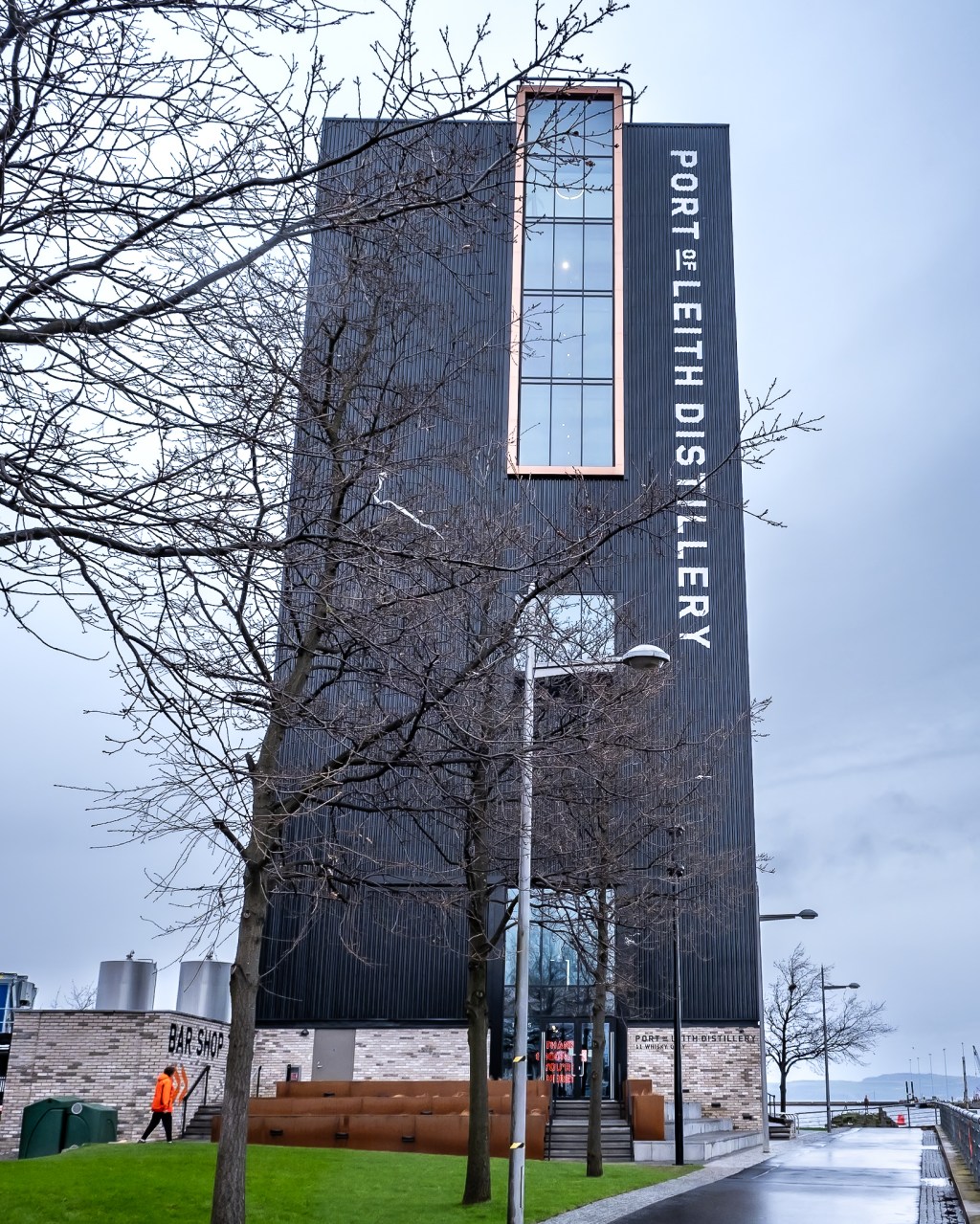
Case in point: Port of Leith Distillery, the towering new single malt scotch whisky distillery planted on the outer edges of Edinburgh’s northern shores.
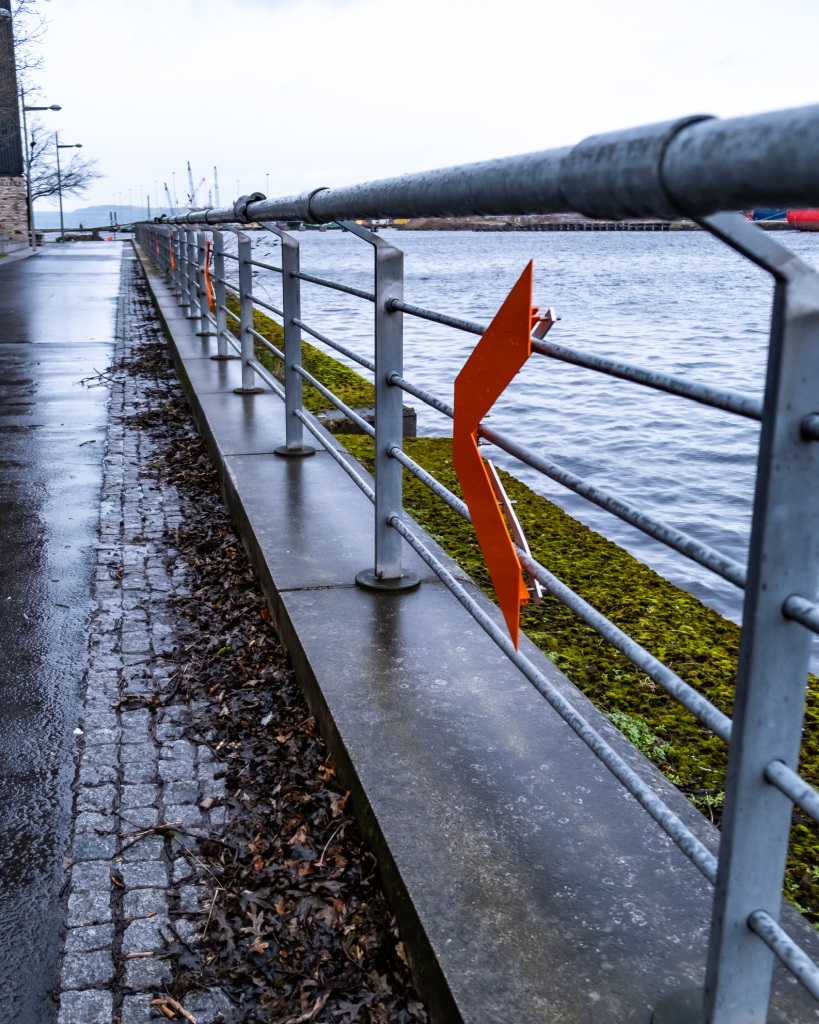
Standing several stories tall, even the bare structure of Port of Leith’s distillation headquarters invite you to consider a new way to whisky. They’re not the only vertical distillery in the world, but they are the tallest. Photographs of the newly-built space’s construction phase reveal wash backs and tanks, glistening in shiny steel, suspended in the air and anchored in place meters above the ground.
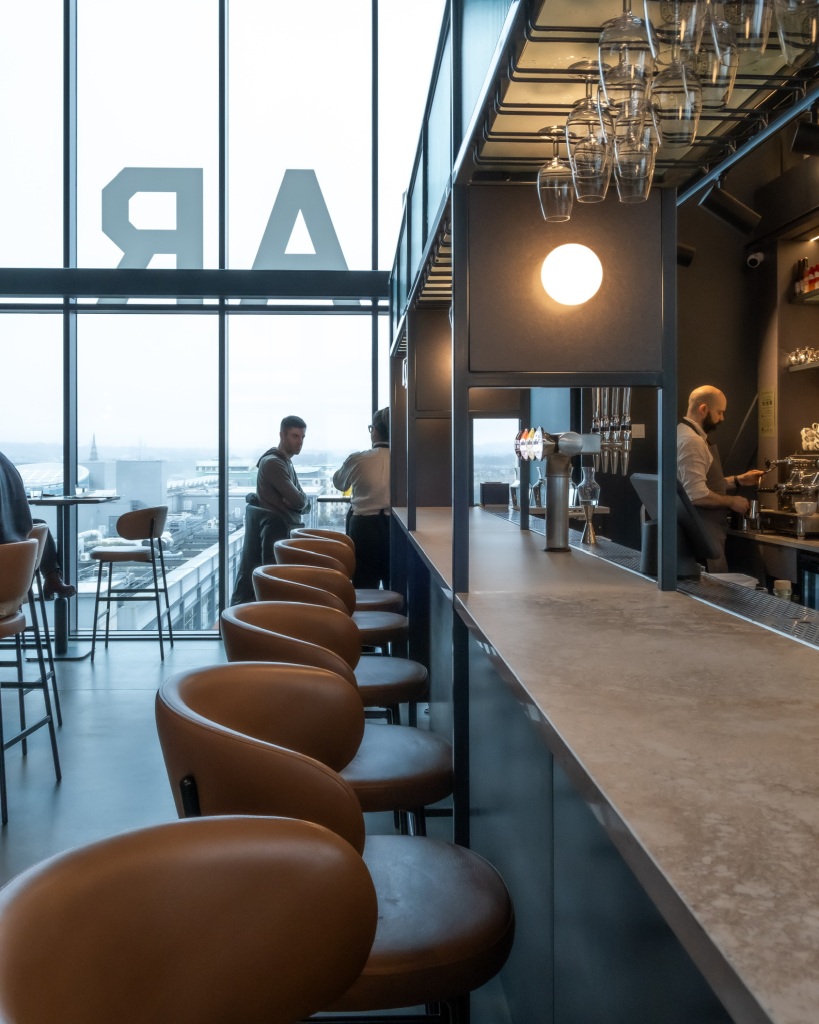
The building is now complete, enclosing those tanks inside its modern walls along with various other equipment, a shop, and a swanky top-floor bar. The look is modern and clean, all dressed in orange and black and white. Entering through the front door, you’re greeted by a brightly lit neon sign: “Thank goodness you’re here!”
Thank goodness, indeed.
But while the distillery is ready for guests, their whisky is not. It’ll be another 8 years before the public gets to taste the first single malt whiskies from Port of Leith.
So what do you do in a whisky distillery that doesn’t have whisky?
Plenty, it turns out.
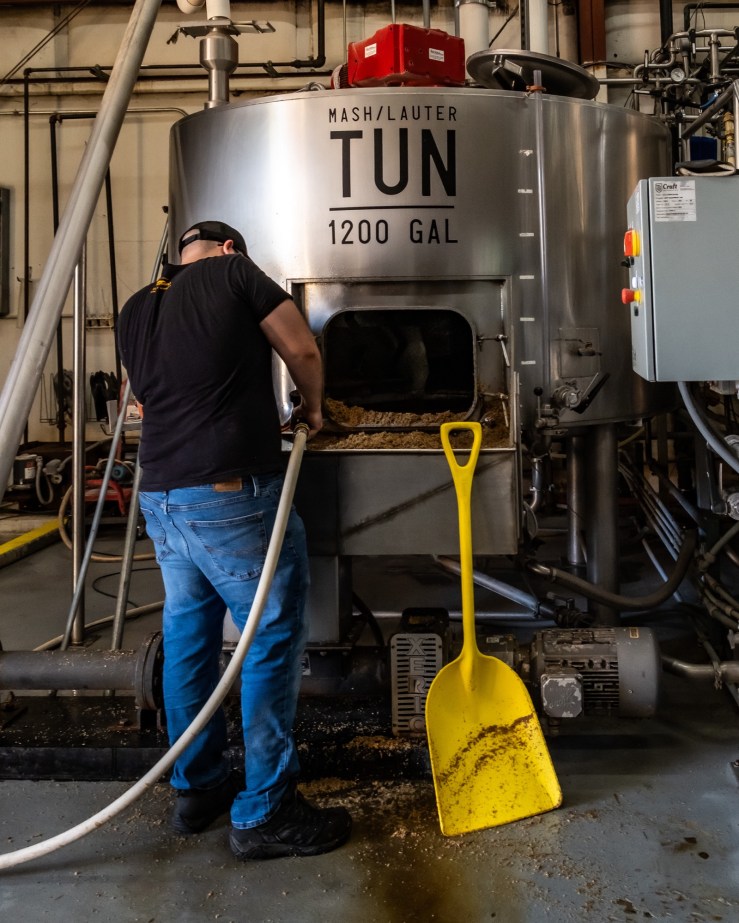
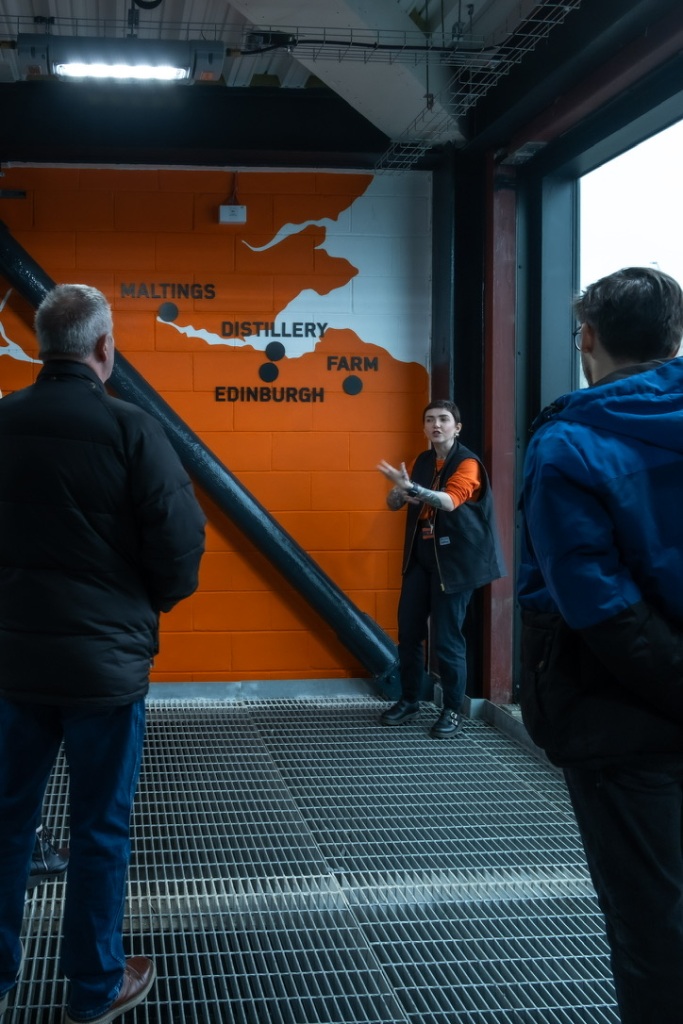
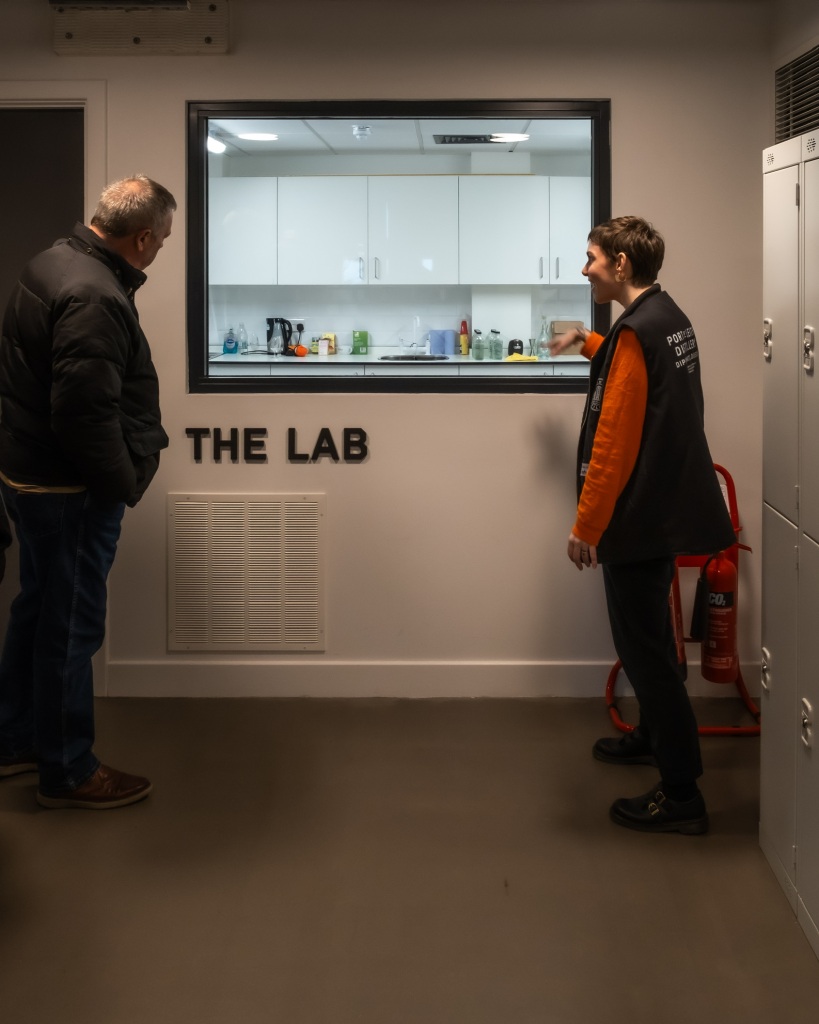
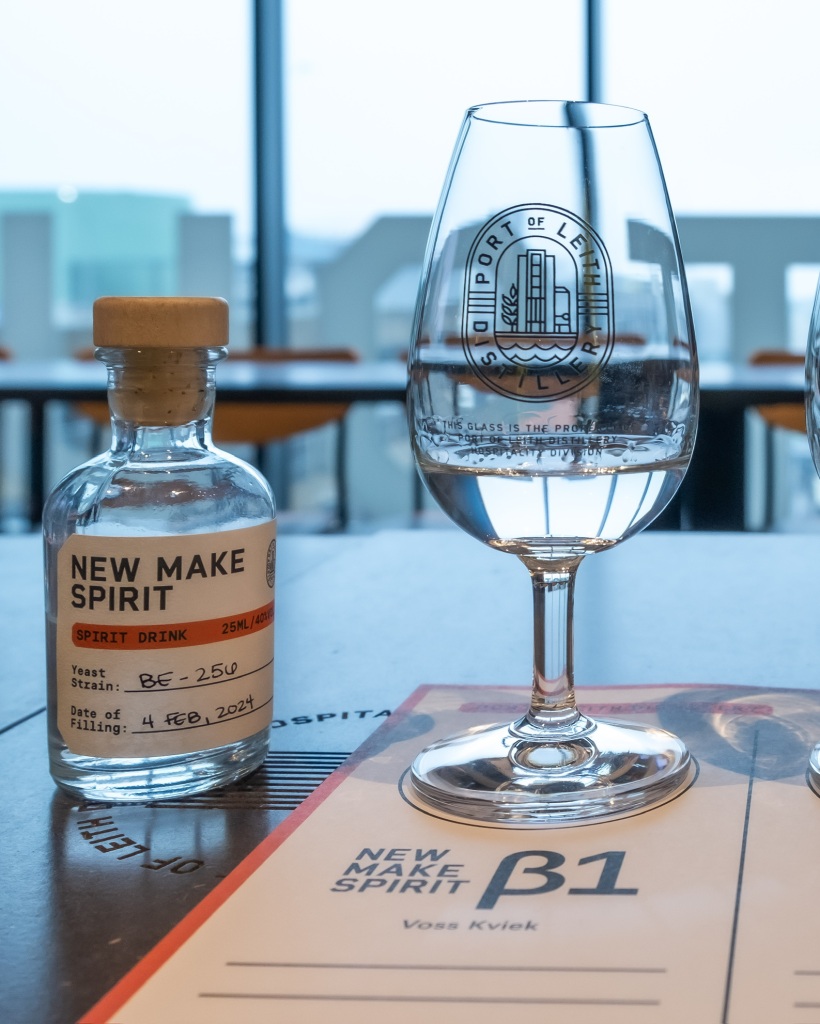
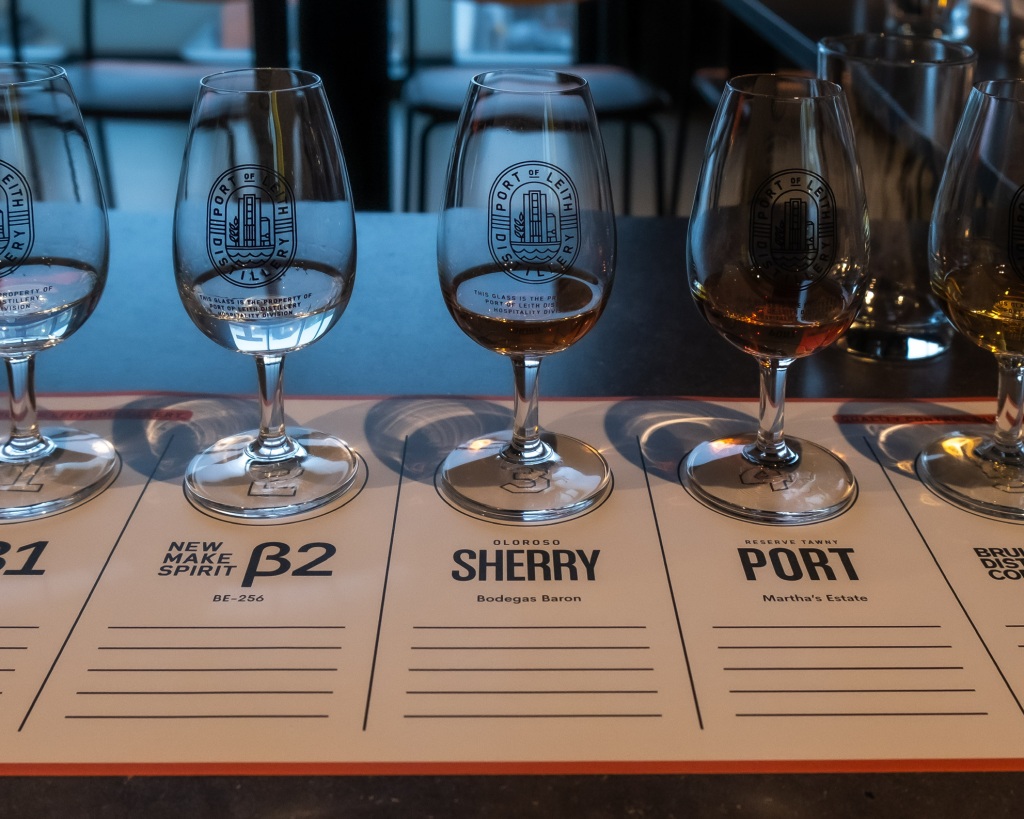
The tour at Port of Leith, a roughly 90-minute event, is not unlike most distillery tours. As you rise and fall through the distillery’s many floors, you can observe the mill and the water tanks and the stills, one wash and one spirit. You can run your hand through the crushed barley grains and see the 1970s cooler box one of the founders borrowed from his parents — it has a purpose, I promise. Your guide, named Ellie in my case, will tell you all about the history of the operation, the grit and determination that led them to their present state. You’ll taste the new make — two different varieties — and learn about the circular practices that make their distillation process sustainable.
If you’ve ever done another distillery tour, however, you’ll quickly note several points of differentiation. First and foremost: the decision to go vertical. While Leith’s limited landscape made it necessary to build up instead of out, it’s a stark contrast to the sprawling whisky estates of Scotland’s more rural settings. But consider also the barrels soon to be employed to age the distillery’s first whisky: rather than sourcing empty casks through a cooperage, the team went straight to the source, buying still-full casks of sherry and port, wrapping their own label around the now-bottled contents.
Whisky distillation is a science, but it’s also an art — and a game of faith. It’s hard to know now exactly what the results of the distillery’s efforts will be several years from now when the first bottles are released.
But while most whisky weighs heavy with the solemnity of tradition, Port of Leith’s joy in the spirit is obvious. You can see it in the bright orange motifs throughout, in the cheeky “property of” notations that adorn their merchandise, and in the curiosity that drives their experimentation with different strains of yeast, something that’s almost unheard of in the current Scotch industry.
Sitting in the distillery’s penthouse bar to wrap up my experience, the appreciation for whisky and innovation was palpable. To start, the whisky selection stretched high to the ceiling, requiring a library ladder to retrieve the uppermost bottles. In addition, the extensive spirits menu focuses on flavor impact rather than region: light and floral vs. big and bold and so on.
For two drams, I enlisted the knowledge of my hosts, ultimately selecting an Ardnamurchan and a private bottling from a Speyside distillery. Both were delicious. As were the chips, which I very much needed after several tipples of whisky and wine.
All in all, it’s hard not to root for Port of Leith’s success. And if you have to wait nearly a decade for whisky, you might as well do it in a 9-story building with stunning views.
Slàinte, y’all!
🥃 The Whisky Type is a self-funded project powered by equal parts curiosity, chaos, and whisky. If you’d like to support Carolyn’s questionable life choices and excellent content, buy her a dram! https://ko-fi.com/thewhiskytype






















 The Whisky Type