Last week, I attended the Stave & Thief Society’s Executive Bourbon Steward Course in Louisville, Kentucky. Our curriculum was, naturally, focused on bourbon. However, one early module went beyond corn whiskey to discuss the various other whiskey categories recognized in the USA. It also included a range of whiskey (and whisky) categories recognized around the world.
As we closed out the chapter, I realized that American Single Malt Whiskey hadn’t been mentioned. I raised my hand to ask about the perceived oversight.
“Well, it’s not an official category,” replied Chris, our instructor for the morning.
“Yeah, I know,” I acknowledged.
That was the end of the conversation.
Little did we know, American Single Malt Whiskey was, in fact, a legally-defined whiskey category that day. In fact, the Alcohol and Tobacco Tax and Trade Bureau (TTB) had announced its planned ratification of the category just one day before, on December 12, 2024. The news simply had not yet reached my class of mostly bourbon aficionados.
Since then, the whiskey world has erupted with chatter about this new and exciting category. Congratulations and questions have flowed in tandem, both in the American whiskey community and those overseas. The questions I’ve seen often stem from expectations set by more established single malt regions, leading to confusion about what the American Single Malt Whiskey category is—and why its regulations have been established as they are.
So grab a glass of whiskey, and let’s dive in.

History of American Single Malt Whiskey
While malted barley was the grain of choice for whiskey distillation in Scotland and Ireland, it grew poorly in most New World soils. Instead, the earliest American distillers focused on rye. Thanks to a variety of sociopolitical, agricultural, and other factors, bourbon, a corn-based, barrel-aged liquor, quickly overtook rye both in terms of production and status. For 200+ years, bourbon has reigned supreme as the nation’s native spirit, even receiving an official designation as such in 1964.
While limited quantities of barley have been used in bourbon and rye production for centuries, the first known American Single Malt Whiskey was not made until the mid-1990s. Raw barley is more expensive than rye or corn, and demand for single malt whiskeys simply didn’t justify the cost of experimentation for most American distilleries.
Clear Creek Distillery, founded by Steve McCarthy and now part of Hood River Distillers, was the first to take a chance on malted barley. With the release of McCarthy’s Oregon Single Malt Whiskey, the distillery introduced a traditional-yet-unexpected spirit to the American whiskey scene, lighting a slow fuse that eventually led to an small explosion of American Single Malt Whiskey distillers and enthusiasts.
Today, hundreds of distilleries across the nation are making some type of American Single Malt Whiskey. The American Single Malt Whiskey Commission (ASMWC) counts more than a hundred of these distilleries as members. These include craft distilleries like the category’s catalyst, Clear Creek Distillery, established bourbon makers like Jim Beam, and Tennessee whiskey pioneer Jack Daniels.
What is American Single Malt Whiskey?
The American Single Malt Whiskey Commission was founded to “establish, promote and protect the category of American Single Malt Whiskey.” Created by some of the category’s first producers, they drafted and refined the original guidelines for what should be labeled as American Single Malt Whiskey:
- Made of 100% malted barley
- Distilled entirely at one distillery
- Mashed, distilled, and matured in the USA
- Matured in oak casks no larger than 700 liters
- Distilled to no more than 160 proof (80% alcohol by volume)
- Bottled at no less than 80 proof (40% alcohol by volume)
- If labeled as American Straight Single Malt Whiskey, aged for at least two years
These requirements draw on established practices in American whiskey while also leaving room for the creativity and innovation that sets American Single Malt Whiskey apart.
The lack of a minimum age statement (unless labeled as straight whiskey or bottled in bond), a maximum distilled proof of 160, and a minimum bottled proof of 80 are all common to American whiskey regulations.
Unlike single malt Scotch and Irish Whiskey, any type of still can be employed for the production of American Single Malts, including column, pot, and hybrid stills. Unlike bourbon and rye, distillers can also choose to age their new make spirit in used or new barrels with the interior either toasted or charred.
For many years, American Single Malt Whiskey has operated out of a so-called “gentleman’s agreement,” with most—if not all—single malt distilleries in the USA following the established guidelines. With the ratification of American Single Malt Whiskey as an official TTB category, these once-loose guidelines are now law. The official ruling was published on December 18, 2024 and goes into effect on January 19, 2025.
What does the TTB’s recognition of American Single Malt Mean for the Industry?
The ASMWC has fought tirelessly for legal recognition of American Single Malt Whiskey for the better part of a decade. At the same time, its member distilleries have been successfully producing, labeling, and selling their spirits as American Single Malt Whiskey. So why does the ratification of this new category—the first in 52 years—matter?
To answer that question, I called my friend Mark A. Vierthaler, the head distiller at Whiskey Del Bac and, in full disclosure, a former colleague. I worked at Del Bac as a tour guide for about six months back in 2021 and 2022. I also objectively love their whiskey—partly due to Mark’s expertise and influence on its production over the last few years. I knew that he could help me understand the full impact of this moment in whiskey history.
What the TTB’s Recognition of American Single Malt Whiskey Means to the Category
Mark immediately pointed to one word to describe the importance of the TTB’s ruling: legitimization.
” The ratification and recognition of ASMW shows consumers—locally, nationally, globally—that what distilleries like Whiskey Del Bac have been doing for more than a decade and a half has just as much cachet as bourbon, rye, [and] wheat whiskey—whichever American whiskey you choose,” he explained. “It makes it easier to educate consumers, creates trust in the category, and encourages more distilleries to begin experimenting with this American take on a classic style of whiskey.”
Mark’s clear explanation especially resonated with me due to an experience I had earlier this year. On a trip to England and Scotland, I stashed a couple bottles of Whiskey Del Bac in my suitcase, eventually sharing them with friends who work in the Scotch whisky industry.
“This is actually pretty good,” my friend Jon said, after taking a sip.
It was the “actually” that got me—of course I wasn’t going to drag bad whiskey across the ocean. But I couldn’t blame him for his response; because experience and knowledge of the American Single Malt Whiskey category has been so limited, so are the expectations for its spirits. According to Mark’s predictions, the formalization of the category will change that.
What the TTB’s Recognition of American Single Malt Whiskey Means to Distillers
As a follow-up, I asked Mark what American Single Malt distillers hope will come from the TTB’s new regulations. He told me that innovation and transparency are two of the most important elements of the ruling.
“Without an official designation, and American Single Malt Whiskey falling under the amorphous umbrella known as ‘Distilled Spirits Speciality,’ you could claim you were single malt, but there were no methods to ensure that you were following the spirit of the guidelines,” he explained.
In short, American Single Malt Whiskey distillers—or those who claimed to be—had no real accountability or obligation to follow the ASMWC’s guidelines. Now, distillers and consumers will know that anyone with American Single Malt Whiskey on the label are playing by the same rules. That allows distillers in to explore and expand on the category’s potential even more.
“With this being made into law, it allows distillers to continue to push the boundaries of what single malt means, while still holding true to a transparent standard,” Mark said. “The designation of American Single Malt shows that American ingenuity and whiskey-making expertise isn’t limited to one category.”
As an example, he explained, “Whiskey Del Bac was inspired by the Scottish model, but not defined by it. Like our fellow American Single Malt producers, we’re showing that single malt is so much more than what people think it is.“

How to Learn More About American Single Malt Whiskey
As with any spirit, there are two ways to learn about American Single Malt Whiskey: in a glass or in a class. For the discerning whiskey enthusiast, the best option might be both.
American Single Malt Whiskeys to Try
With hundreds of Single Malt Whiskeys being produced in the USA every day, there’s no shortage of whiskeys to sample. Many people can find a bottle of Clermont Steep, made by Kentucky giant Jim Beam, at the local whiskey shop.
For a deeper glimpse into the quality and innovation embodied by the category, consider buying a bottle from one of the craft distilleries who helped to define it.
Here are a few of my favorites to consider.
1. Whiskey Del Bac. I’ve been transparent in my bias toward Whiskey Del Bac, but I’m not alone in my appreciation of this Southern Arizona distillery. While they’re best known locally for Dorado, made with mesquite-smoked malted barley, it’s the Classic, a straightforward, unsmoked single malt, that’s making national waves. Still one of my favorite American whiskeys, the Classic received a 93 rating from Whisky Advocate in 2021.
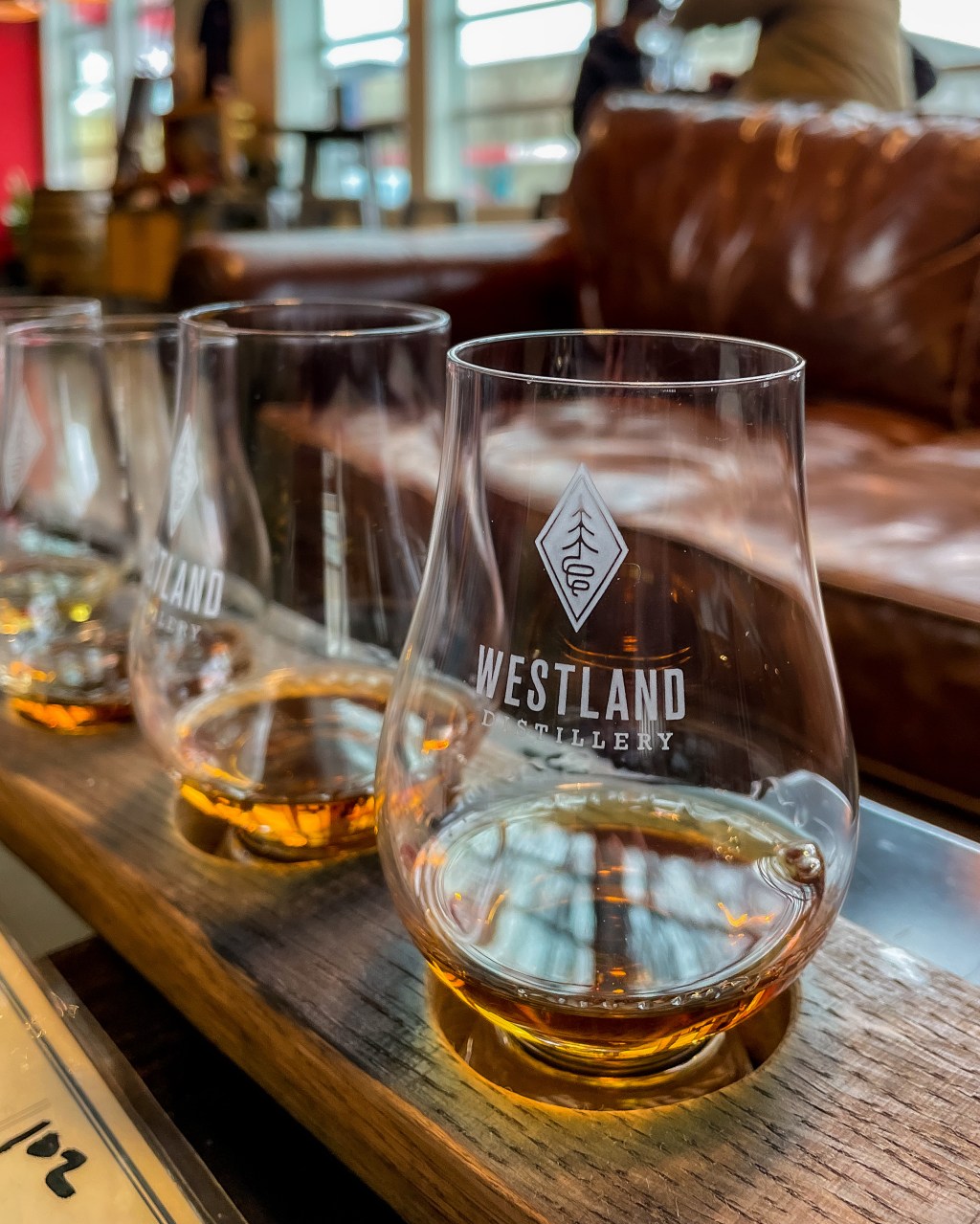
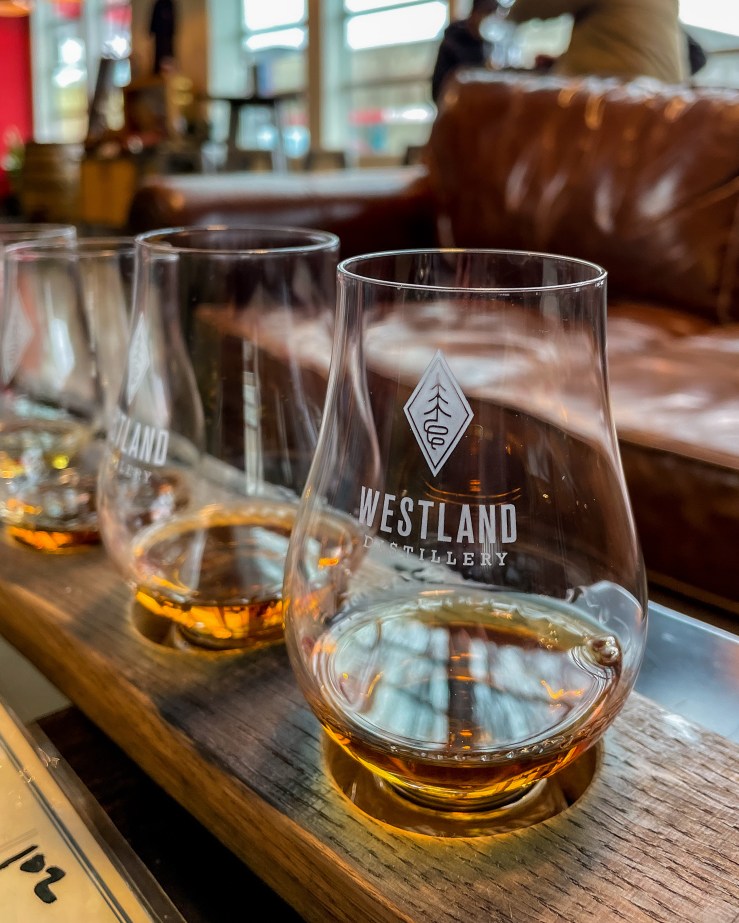
2. Westland Distillery. Based in Seattle, this innovative distiller is taking a nerdier approach to whiskey. When I visited the distillery in 2022, I learned about their use of local oak quercus garryana—and a PhD-level exploration of barley varieties too. Their new core range features their Flagship American Single Malt Whiskey as well as whiskeys finished in wine and beer casks.
3. Minden Mill Distilling. Located outside of Reno, Nevada, Minden Mill’s spirits are a reminder that whiskey is, primarily, an agricultural product. Early farmers often distilled their excess grain as a way to use up overstock and supplement their income. Minden Mills now employs this same farm-to-bottle mentality, harvesting their own grains to produce “single estate whiskey.”
4. Andalusia Whiskey Co. Stryker, the flagship American Single Malt Whiskey from Andalusia Whiskey Co., features barley smoked over oak, cherry, and mesquite woods. Together, the imparted flavors reflect the unique terroir of the distillery’s Central Texas location. I received a bottle of Stryker last year as a thank you for dog sitting. Then unfamiliar, it has become a daily sipper.
5. Lost Lantern Whiskey. As a blender and independent bottler, Vermont’s Lost Lantern Whiskey doesn’t make its own spirits. Instead, they work with distilleries throughout the country, frequently engaging American single malt makers to produce a unique range of whiskeys. Flame, which marries spirits from Santa Fe Spirits and Whiskey Del Bac, was named the “Best American Blended Malt” at the 2024 World Whiskies Awards.
Because of the category’s still-growing prestige (and the challenges of in-country distribution), many of these notable whiskeys can be hard to find. That means that even an American Single Malt Whiskey enthusiast like me still has barely scratched the surface in tasting the incredible whiskeys out there (hint, hint, distillers….send me your samples…).
Despite the challenges of finding American Single Malt Whiskeys on the shelf, these spirits—and many others not listed here—are absolutely worth a sip.
Classes to Build Your Knowledge of American Single Malt Whiskey
Some of us like to pair our whiskey sips with certifiable expertise. For the nerds like me, here are two courses to take your American Single Malt Whiskey knowledge to another level:
- The Edinburgh Whiskey Academy’s Certificate in American Single Malt Whiskey. Launched in 2024, this online certification course was produced in partnership with the ASMWC. I was part of the EWA’s pilot program, and I was hired to do a final round of edits to the course content too. Like all of the EWA’s course offerings, the American Single Malt Whiskey Certificate offers a thorough dive into the category. But the best part is the videos: featuring whiskey makers and ASMWC leadership, the class videos provide unique insights from those that know American Single Malt Whiskey best.
- Courage & Conviction ASM Academy. This free course from Virginia Distilling Company (another great single malt distiller to try) offers a four-part overview of American Single Malt Whiskey. It covers an overview of the category, production, and sipping the whiskey before wrapping up with an introduction to Virginia Distilling.
Of course, if you prefer to keep your nose out of the books and in the glass, that’s perfectly okay too. The most important thing for any whiskey enthusiast to know is that American Single Malt Whiskey is officially here—and it’s here to stay.
Sláinte, y’all!
🥃 The Whisky Type is a self-funded project powered by equal parts curiosity, chaos, and whisky. If you’d like to support Carolyn’s questionable life choices and excellent content, buy her a dram! https://ko-fi.com/thewhiskytype












 The Whisky Type